The best track pump for a household with several bikes
A household with four bikes has three valve types and a weekly job nobody wants to do. What makes that job disappear is a pump tall enough to work with body weight, a head that fits everything without an adapter, and a gauge you can read while pushing.
Barrel height, valve coverage, and a gauge you can actually read at floor level.
The order, and why
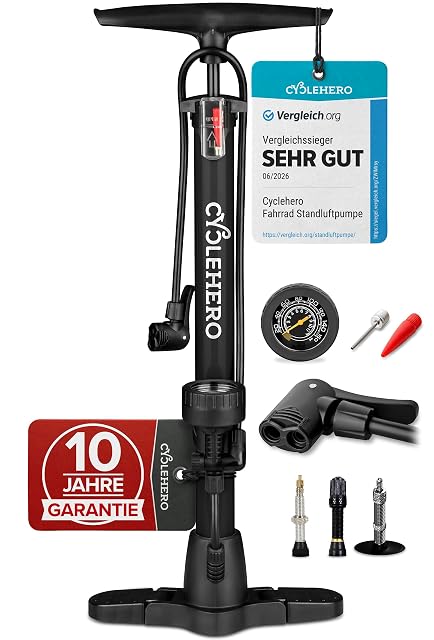
1. CYCLEHERO track pump. Sixty centimeters of steel, eleven bar, a 25 cm base and a ten-year warranty. The base is the part nobody looks at and the part that decides whether the pump stays upright when a child leans on it. The ten-year warranty is the longest stated in this hub, on a product whose usual failure is a perished seal — which is precisely what a long warranty covers.
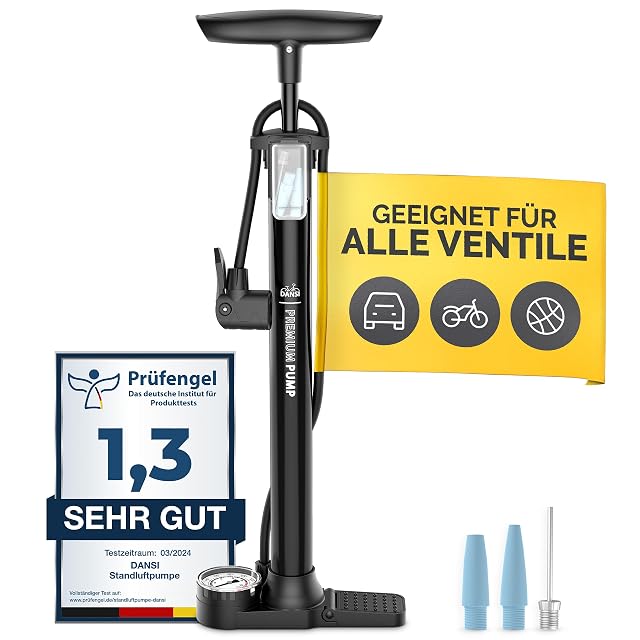
2. DANSI Basic. Sixty centimeters, a dual head covering SV, AV and DV, and a manually adjustable target marker on the gauge. That marker is the feature for this question: set it once per bike and a weekly check becomes a visual match rather than a reading. It is the best-selling pump on this site. It does not publish a maximum pressure, which is worth confirming if you run road tires at seven or eight bar.
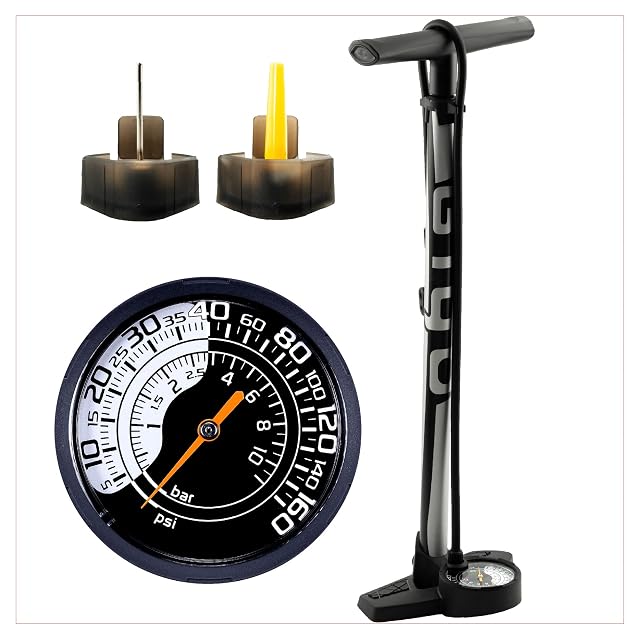
3. GIYO GF27DH. A precision gauge with separate low and high ranges, and a one-hand head. The dual-range gauge is the right answer for a household spanning a mountain bike at two bar and a road bike at eight — a single-scale gauge is imprecise exactly where low-pressure tires live.
What to check before you buy
Look at the valves on every bike in the house before you order. One Dunlop valve among four bikes rules out any pump with a Presta-and-Schrader-only head.
Which one fits how you ride?
You have several bikes
A track pump that handles every valve type in the house saves adapters and arguments.
You care about pressure
A gauge you can actually read at the pressure you use is worth more than a wide range you never approach.
You run tubeless
A pump with a charging chamber, or a separate tubeless inflator, because seating a tire needs a sudden burst.
You also inflate car tires and toys
Check the valve compatibility and the maximum pressure, since these are different requirements.
Picking by how you ride
Weekly pressure checks
The main use, and the habit that prevents most punctures and most bad rides.
A household of mixed bikes
Where dual-head or auto-switching valve compatibility saves constant fiddling.
Seating tubeless tires
Where a standard track pump often fails and a charging chamber or a compressor is needed.
Other inflatables
Where a needle and cone adapter turn the pump into a household tool rather than a bike one.
What really separates these
The gauge and where it reads
A gauge that is precise near your usual pressure matters far more than a high maximum. Gauges on cheap pumps are indicative rather than accurate.
Valve compatibility
Presta and Schrader at minimum, ideally without swapping parts. A head that switches automatically removes a daily annoyance.
The head and how it locks
The part that fails. A head that leaks or pops off under pressure makes the pump useless while the barrel is fine.
Stability and base
A wide, stable base and a comfortable handle. You will lean on it, and a pump that skids is a pump that ends up in the shed.
Tubeless capability
A charging chamber stores air and releases it in a burst. Without one, seating a stubborn tubeless tire often needs a compressor.
Which figure for which ride
Your household
The pump
The extra
Mixed bikes
Auto-switching head
None
Road bikes
A gauge accurate at high pressure
None
Tubeless
A charging chamber
Or a compressor
Bikes plus toys
Needle and cone adapters
Check maximum pressure
Where riders go wrong
Trusting a cheap gauge as accurate
Most are indicative rather than precise. If exact pressure matters to you, a separate digital gauge is the answer.
Buying on maximum pressure
A very high maximum usually means a gauge that reads coarsely at the pressure you actually use. That is the wrong trade for most riders.
Ignoring the head
It is the part that fails and the part you touch every time. A pump with a replaceable head outlives one without.
Over-inflating to the tire's maximum
The sidewall maximum is a limit, not a target. Comfort, grip and rolling resistance are usually better somewhat below it.
By the kind of rider you are
The family household
An auto-switching head, a stable base, and adapters for footballs and toys.
The road rider
A gauge that reads clearly at their pressure, and a head that locks securely.
The tubeless user
A charging chamber pump, or a track pump plus a separate way to seat tires.
Servicing and how long it holds up
Track pumps are simple and they fail at the head seal and the hose. A pump that will not hold pressure has a perished seal or a split hose, and both are usually replaceable rather than terminal.
Replace the head seal when it starts leaking rather than replacing the pump.
Check the hose where it meets the barrel; that is where it splits.
Keep the head clean; grit destroys the rubber that grips the valve.
Store it indoors; damp and cold shorten hose and seal life.
Safety
Compressed air and a tire that can fail suddenly.
Never exceed the maximum pressure marked on the tire sidewall.
Check the tire is seated evenly all round before inflating fully.
Keep your face away from the wheel while inflating a tire you have just fitted.
Stand the pump on a firm surface; a pump that skids under load can trap fingers.
60 cm (23.6 in) steel · 11 bar · 25 cm (9.8 in) base · 10-year warranty
A 60 cm (23.6 in) steel track pump with a 25 cm (9.8 in) base, a 22 cm (8.7 in) handle and a 65 cm (25.6 in) hose, rated to 11 bar and carrying a ten-year manufacturer warranty.
Best for: A pump bought once, for a household that will still be inflating tires in ten years.
60 cm (23.6 in) barrel · dual head SV/AV/DV · gauge with marker
The best-selling track pump here: a 60 cm (23.6 in) barrel on a wide base, a dual head sealing on all three valve types, and a gauge with a manually adjustable target marker.
Best for: The default household track pump, for a family of bikes at mixed pressures.
Precision gauge, low and high range · one-hand head · 11 bar
A track pump with a large gauge specified for both low and high pressures and a one-hand locking head, rated by its manufacturer to 11 bar and supplied with adapters.
Best for: Riders running gravel, mountain bike or fat tires, where reading 1.5 bar accurately is the whole job.
Presta (SV), the narrow one with a threaded tip, on road and most modern bikes. Schrader (AV), the car-style one, on mountain bikes and many hybrids. Dunlop (DV), still standard on European city bikes, with a Presta-shaped tip on a wider body. A dual or triple head takes them without an adapter to lose.
How tall should a track pump be?
Tall enough that you are pushing down over the handle with your body weight rather than bending. Sixty centimeters is the usual answer for an adult, and it is the difference between a chore and a non-event across four bikes.
How accurate is a track pump gauge?
Generally within a few percent, and none of these publishes a tolerance. What matters more for a weekly check is repeatability and legibility: reading the same number the same way each week catches a slow leak, and the exact figure matters less than most people think for anything but road tires.
What pressure should I run?
The sidewall maximum is a limit, not a target. Comfort and grip are usually better somewhat below it, and the right figure depends on tire width and your weight.
Will a track pump seat a tubeless tire?
Often not. Seating usually needs a sudden burst of air, which is what a charging chamber or a compressor provides.
Presta or Schrader?
Bikes use both, sometimes within one household. A head that handles both without swapping parts removes a daily irritation.
My pump will not hold pressure. Is it finished?
Usually a perished head seal or a split hose, and both are commonly replaceable. Check before replacing the whole pump.
How often should I check pressure?
Weekly is the common advice, because tires lose pressure steadily and low pressure causes both punctures and hard work.
Spares and fitting kit from the same aisle, at the price we read. Confirm they match the bike and the part you chose before ordering: it turns on the standard and the part number, which the listing gives.
Bell 1001999 · Inner tubes — 26" × 1.75-2.25 · Schrader 35 mm (1.38 in) · mold-cured · $7.99
Everything listed is drawn from the catalog of this site. Specifications are the published ones, from the maker and from Amazon; prices are what Keepa recorded on the date shown, and both move. The order rests on declared specifications, on stated strengths against stated limits, and on price. None of this kit has been ridden by us, and the page makes no such claim.
Last checked on
Prices quoted in these summaries are dated readings. The live price is shown next to each product.
The tool we use ourselves
Chosen your tool? Now buy it at the right price.
Bike racks, trainers and computers swing by thirty dollars or more across the year, and
the biggest "discounts" often land at prices the same model sold for six weeks earlier.
UniverTrack tracks the real price history across retailers, spots fake
reductions, and alerts you when it is genuinely the moment to buy.
Real price historyBuy-now alertsAI buying assistant