Skip to content

The best panniers and bikepacking bags for 2026

Waterproofing is a construction question, not a coating one: a welded roll-top has no seam holes and no zip to fail, while a zipped bag with a water-resistant coating will eventually let water past the zip in sustained rain. We compare stated capacity in liters, closure construction, which rack rail diameters the mounting hooks accept, and whether the hooks lock or simply rest — the detail that decides whether a pannier stays on over a curb.

The models we recommend

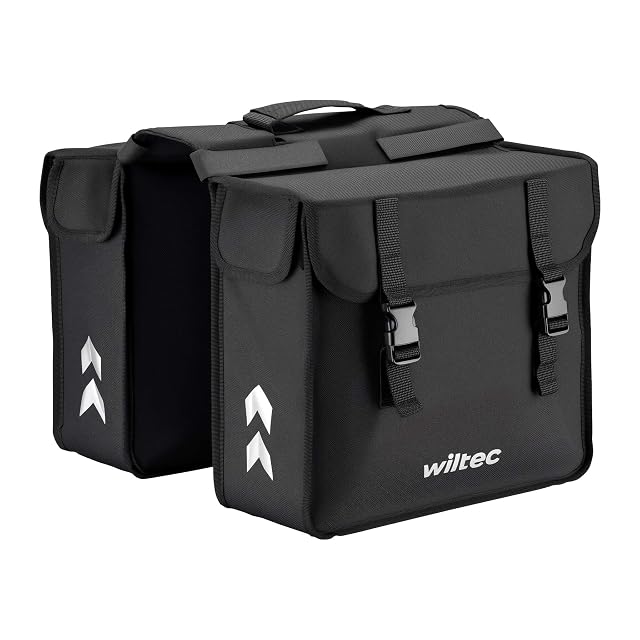
  1. Wiltec Double pannier set, 30 L

    30 L · 35 × 13 × 30 cm (13.8 × 5.1 × 11.8 in) · polyester · water resistant

    A double pannier at the entry price: 30 liters across both sides in a polyester construction described as water resistant rather than waterproof.

    Best for: Commuting in mostly dry conditions, or as a first pannier before committing to a waterproof set.
    7.2/10

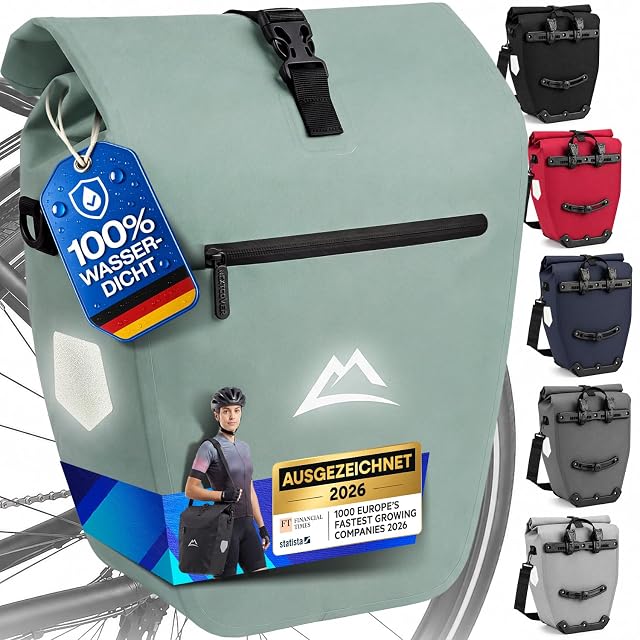
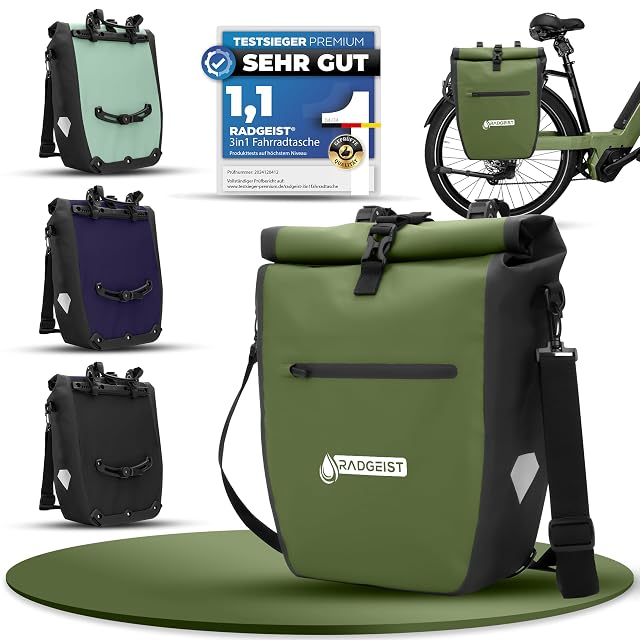
  2. RADGEIST Waterproof pannier with shoulder strap

    100% waterproof stated · rails 8–16 mm (0.31 to 0.63 in) · reflectors · shoulder bag

    The best-selling pannier here: stated as 100% waterproof, with an adjustable fitting for rack rails of 8 to 16 mm (0.31 to 0.63 in) and integrated reflectors.

    Best for: Daily commuting where the bag has to come off the bike and go into a building.

    7.8/10

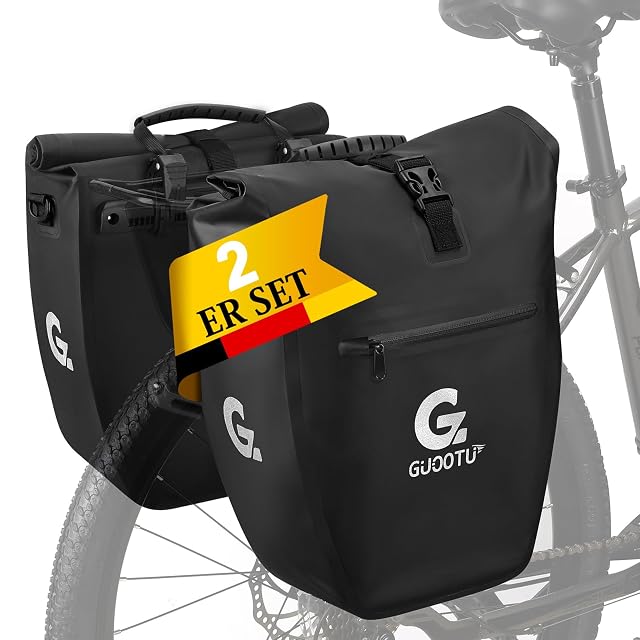
  3. GUOOTU Pair of 24 L panniers, 48 L total

    2 × 24 L = 48 L · high-frequency welded PVC · tool-free buckles

    A pair of 24-liter panniers in high-frequency welded PVC, mounting with improved buckles in two steps and no tools, with reflectors and a shoulder strap.

    Best for: Touring and heavy shopping, where a balanced pair and welded seams both matter.

    7.8/10

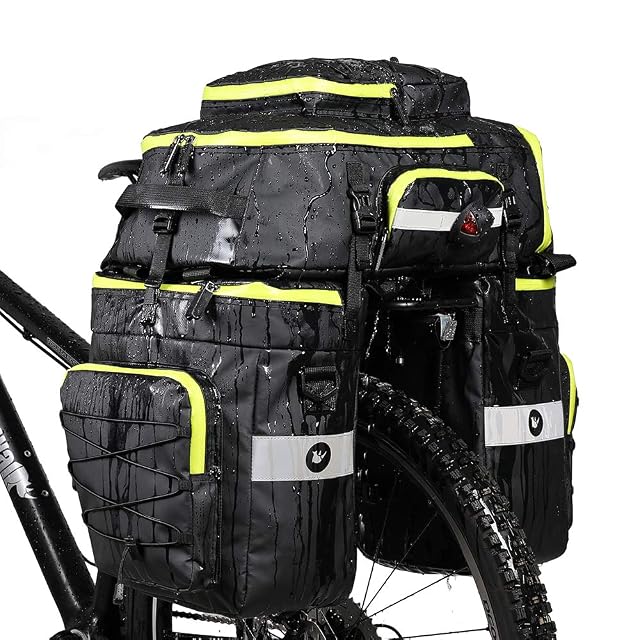
  4. BAIGIO 3-in-1 pannier system, 75 L

    75 L total · top bag plus two side bags · PVC polyester · waterproof zips

    A three-piece system totaling 75 liters — a top bag and two trapezoidal side bags — in PVC-coated polyester with waterproof zips.

    Best for: Loaded touring, where capacity is the constraint and the rack is rated for it.

    8.4/10

For which need, in panniers and bikepacking bags

Carrying volume

Capacity decides how self-sufficient a trip can be. In bikepacking it is spread across several bags rather than concentrated.

BAIGIO WTSM-RK19665

Carrying what a day needs

A small bag is enough for a commute and does not weigh the bike down for nothing.

Nextcover NC-RBAG-MNT-TPU

Keeping rain out without an extra cover

A coated-canvas pannier lets water through the seams after an hour of rain. The stated waterproof rating, not the word water-repellent, decides what arrives dry.

BAIGIO WTSM-RK19665

For whom, within panniers and bikepacking bags

Daily journeys
A pannier on a rack carries more and unclips in one movement. It is more comfortable than a backpack on the commute.
Touring with a rack
Classic panniers carry a lot and carry it low, which steadies the bike. It is the highest-capacity format.
Bikepacking
The bags fix to the frame with no rack, on a bike that will not take one. The volume is smaller and better spread.

What each advantage costs, on panniers and bikepacking bags

Panniers against frame bags
Panniers carry a lot and require a rack; bikepacking bags fit anywhere and carry markedly less.
Waterproofing against access
A roll-top closure is genuinely waterproof and slow to open; a zip is quick and lets water in.
Volume against how the bike handles
A load carried high and at the front makes the steering vague. Distribution matters as much as total weight.

Before buying panniers and bikepacking bags

Panniers or bikepacking bags?

Panniers carry far more and need a rack; frame bags fit on any bike and carry less.

How should the weight be distributed?

Low and near the center of the bike. A load carried high and at the front makes the steering vague and unstable downhill.

Are the bags waterproof?

Roll-top closures genuinely are; zips rarely are. A rain cover or inner dry bags complete them.

Do panniers catch your heels?

It is the most frequent problem, solved by sliding the pannier back along the rail. Check before setting off, not after ten kilometers.

Do I need a specific rack?

The mounting system has to suit the diameter of the rail. The rack's permitted load is a limit too.

Can I use a backpack instead?

On a short trip, yes. Weight on the back tires you and makes you sweat far more than weight carried by the bike.

How do I protect electronics?

In a dry bag inside the bag, whatever waterproofing rating is stated. The closures are always the weak point.

How should the load be spread between panniers?

Weight goes low and close to the wheel axles, balanced between the two sides. A two-kilo imbalance shows in the steering from the first corner.

What to remember about panniers and bikepacking bags

Load low and near the center: weight carried high and at the front makes the steering vague. Heel strike is fixed by sliding the pannier back along the rail, and electronics go in a dry bag inside, whatever waterproofing is claimed.

A quick look at panniers and bikepacking bags

  • Highest figure for capacity: BAIGIO WTSM-RK19665 (75 liters across three bags).

Panniers and bikepacking bags in one table

To appear here, a characteristic has to be stated by four items in five. Short of that, the column would mostly say nobody publishes.

ModelPriceCapacityFitting
BAIGIO WTSM-RK19665—75 liters across three bagsTwo metal hooks and a hook-and-loop strap per side
Nextcover NC-RBAG-MNT-TPU—28 litersTool-free adjustable click system
RADGEIST RG-PBC———
GUOOTU EWQ—2 × 24 liters, 48 liters totalImproved buckles, two steps, no tools
Wiltec 65667—30 litersMost conventional bikes with a rack

Also worth reading on panniers and bikepacking bags

Sources and how we rank

Specifications: manufacturer sheets for bike gear and the matching Amazon product pages. Prices and availability: Keepa. Every figure in this table names its source.

Most recent revision in this category: August 30, 2026.

How we assess panniers and bikepacking bags