These three look like the same product and protect against completely different things. One is a cover that packs into a jersey pocket, one is a padded bag for a car, and one is built for baggage handling. Buying the wrong one is either carrying weight you never use or arriving with a bent rotor.
Packed size, padding, and the wheelbase or bike size the bag actually takes.
Those three pull against each other. Packed size and padding are opposites, and the bag that is easiest to carry empty is the one that protects least.
The order, and why
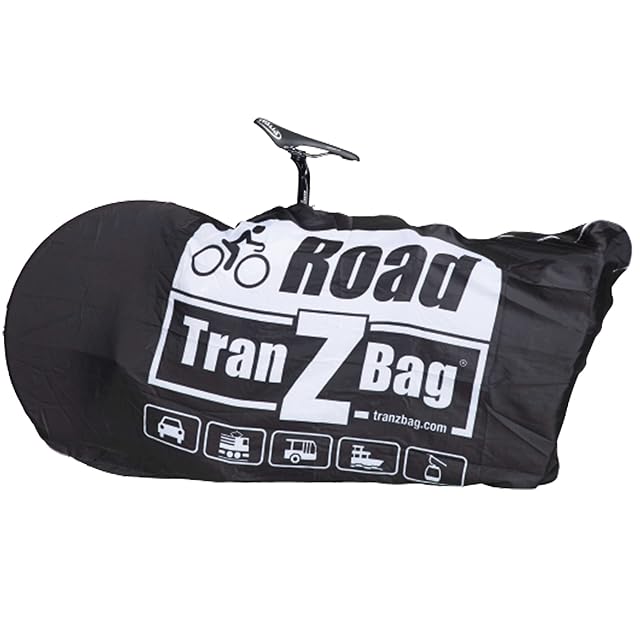
1. EVOC TranZbag ROAD. Packs down to fit a jersey pocket or a bottle cage, closes in seconds, and has a front wheel pocket. That is the train answer and nothing else here comes close to it: the whole point is that the bag is with you on the outward ride, so the train home is an option rather than a plan. It protects against dirt, chain grease and scuffs, and not against a baggage handler.
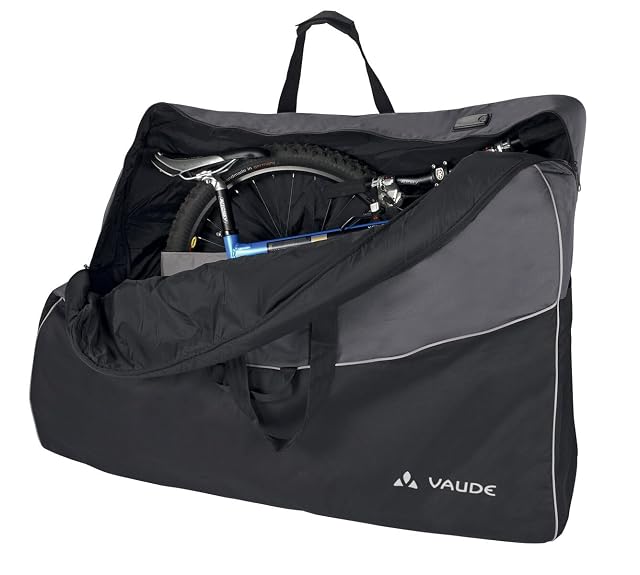
2. VAUDE Big Bike Bag. A full-perimeter zip so it opens flat rather than into a hole, a carry handle, an address pocket and a padded wheel compartment. The padded wheel compartment is the detail that matters: wheels packed loose against a frame chip paint and bend rotors. This is the car, van and long-distance-coach answer. VAUDE publishes no dimensions, weight or bike size range on this listing, so confirm both with the seller.
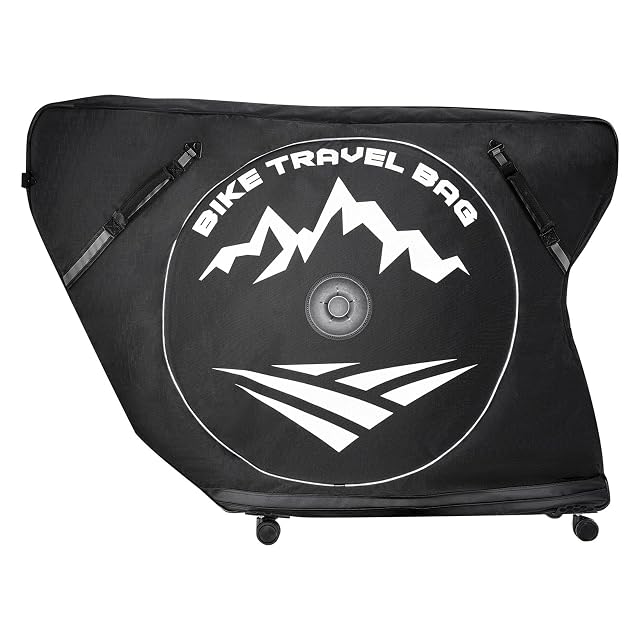
3. VEVOR triathlon travel bag. A stated maximum wheelbase of 106 cm — the most useful single figure in this hub, because it is what actually decides whether a bike fits — plus a TSA lock, a double zip, two wheel compartments and rollers. Rollers and a TSA lock are flight features. It is third for the train question and first if the question is a flight.
What to check before you buy
Measure your wheelbase, center to center, and your empty bag weight against the airline allowance if a flight is in the plan. And find out whether your bike shop will pack it — several will, and it is worth the money the first time.
Which one fits how you ride?
You take a bike on trains regularly
The operator's rules decide everything, and they vary by country and even by service.
You have a folding bike
A cover is often all that is required, and folding bikes are frequently exempt from bike restrictions.
You are flying
That is a different product: a hard case or a heavily padded bag, and airline rules on top.
You want to carry the bag afterwards
Where you leave the bag while you ride is the question nobody thinks about until they are at the station.
Picking by how you ride
Trains
Where a light cover often satisfies the rules and where the operator's policy is the real specification.
Flying
Where padding and structure matter, and where the bike needs partially dismantling regardless.
Cars
Where a bag protects the interior and the bike, and where weight matters far less.
Storage
Where a bag keeps dust off a bike but traps damp, which is a real risk over months.
What really separates these
The operator's rules
Some require a bag or cover, some restrict times, some require reservations. Checking before traveling is the whole exercise.
How much the bike must be dismantled
A light cover may take a whole bike; a compact bag needs wheels and pedals off. Decide how much work you accept at a platform.
Packed size and weight
You will carry this through a station. A heavy protective case is right for flying and wrong for a commute.
Where the bag goes while you ride
A cover that folds into a small pouch solves this; a hard case does not. It is the question people forget.
Protection level
A cover keeps a train tidy; it does not protect a bike from baggage handlers. Match the protection to the journey.
Which figure for which ride
Your journey
The bag
The catch
Train commute
A light cover
Check the operator's rules
Flying
A padded bag or hard case
Dismantling and airline fees
Car transport
Any bag
Protects the interior
Riding at the other end
Something packable
A hard case is a problem
Where riders go wrong
Not checking the operator's rules
Policies vary by country, operator and even time of day, and some services require reservations. Turning up and hoping is how journeys go wrong.
Buying a hard case for train travel
Excellent for flying, unusable for a commute, and impossible to store while you ride at the other end.
Assuming a cover protects the bike
A cover is about keeping a carriage clean and satisfying a rule. It is not padding, and a bag handled roughly needs padding.
Not practicing the pack
Removing wheels and packing a bike is slower the first time. A platform with a train coming is a poor place to learn.
By the kind of rider you are
The train commuter
A light packable cover, and the operator's rules known in advance.
The flyer
A padded bag or hard case, and an acceptance of dismantling and airline charges.
The folding bike owner
A simple cover, which is often all that is required and which folds into the bike's own bag.
Servicing and how long it holds up
Bike bags are damaged by being packed with a dirty, wet bike and then stored closed. Grease marks the lining, damp stays for weeks, and the zips take the strain of a bag that is fuller than intended.
Dry the bag fully before storing; a closed damp bag stays damp.
Clean the bike before packing, both for the bag and for the train.
Check the zips and wheels, which take the strain on a loaded bag.
Store it uncompressed rather than crushed, which cracks stiffened panels.
Safety
Carrying an awkward heavy object through a station.
Protect the derailleur and the disc rotors; both bend easily when packed.
Fit axle spacers when the wheels are out, so the frame is not squeezed.
Lift with care: a packed bike is heavy, awkward and easy to drop.
Check the operator's rules before traveling rather than at the barrier.
A full-size bike transport bag from an established German outdoor manufacturer, with a full-perimeter zip and a padded internal compartment for the wheels.
Best for: A full-size bike moved by car or train, where dirt and scuffs are the real threat.
Wheelbase to 106 cm (41.7 in) · TSA lock · double zip · two wheel compartments · rollers
A flight-capable bag for wheelbases up to 106 cm (41.7 in), with two separate wheel compartments, a chain pocket, wheels, a padded handle and a TSA-approved lock.
Best for: Flying with a road or triathlon bike, where a TSA lock and rollers are what the trip actually needs.
Many operators do, and the rules vary by country, by operator and sometimes by service. A bagged bike is frequently carried as ordinary luggage where an unbagged one needs a reservation. Check the specific operator before you travel — the rules change often enough that a bag bought for one route is not a general permission.
Is a soft bag safe for a flight?
Not without padding it yourself. Aircraft hold handling is the harshest thing a bike bag meets, and the part that most often arrives damaged is a disc rotor. A padded bag or a hard case is the answer, and the airline's weight and dimension allowance decides which.
What do I have to remove to bag a bike?
Usually the front wheel and the pedals, and often the handlebars are turned or the stem loosened. Take the rotor off or fit a transport spacer if the bag has no padded wheel compartment, and let some air out of the tires.
Do I need a bag to take a bike on a train?
It depends entirely on the operator. Some require a bag or cover, some restrict times, some require reservations. Check before traveling.
Does a cover protect the bike?
Barely. A cover keeps the carriage clean and satisfies a rule. Real protection needs padding, which is what a flight bag provides.
What do I do with the bag while I ride?
This is the question people forget. A packable cover folds into a pouch; a hard case has to be stored somewhere, which is a genuine problem.
How much do I need to dismantle?
For a light cover, often nothing. For a compact bag or a flight case, wheels and pedals at least, and often the handlebars too.
What gets damaged most in transit?
The rear derailleur and the disc rotors. Both bend easily, and both are worth protecting or removing.
Can I use a flight bag for the train?
You can, but it is heavy, bulky and impossible to store while you ride. They solve different problems.
Spares and fitting kit from the same aisle, at the price we read. Confirm they match the bike and the part you chose before ordering: it turns on the standard and the part number, which the listing gives.
FUCNENbksc-55-blkzx036 · Frame protection and saddle covers — 29 × 27 cm (11.4 × 10.6 in) · silicone gel padding · non-slip underside
Kasanni zt-lh59 · Frame protection and saddle covers — 2 covers · PVC · under 30 g (1.1 oz) · elastic hem
CLIFFORD S-20-HLS · Rack straps and frame adapters — 50 mm (1.97 in) wide · 40–100 cm (15.7 to 39.4 in) adjustable · metal eyelet · silicone anti-slip
Allen 900B · Rack straps and frame adapters — 53.3 × 15.2 × 3.6 cm (21 × 6 × 1.4 in) · for 46–68 cm (18.1 to 26.8 in) bar-to-saddle · internal spring · coated hooks · $25
The one-sentence call
If your first priority is the price → look at EVOC 150503100
Everything listed is drawn from the catalog of this site. Specifications are the published ones, from the maker and from Amazon; prices are what Keepa recorded on the date shown, and both move. The order rests on declared specifications, on stated strengths against stated limits, and on price. None of this kit has been ridden by us, and the page makes no such claim.
Last checked on
Prices quoted in these summaries are dated readings. The live price is shown next to each product.
The tool we use ourselves
Chosen your tool? Now buy it at the right price.
Bike racks, trainers and computers swing by thirty dollars or more across the year, and
the biggest "discounts" often land at prices the same model sold for six weeks earlier.
UniverTrack tracks the real price history across retailers, spots fake
reductions, and alerts you when it is genuinely the moment to buy.
Real price historyBuy-now alertsAI buying assistant