The best bike light for roads with no street lighting
On a lit street, a light exists to be seen. On an unlit lane it has to show you the surface, and those are different jobs with different numbers. Lux measures illumination on the road; lumens measure output at the source. This list is ordered on lux.
The stated lux figure, whether the beam is approved, and how long the front lamp runs.
The order, and why
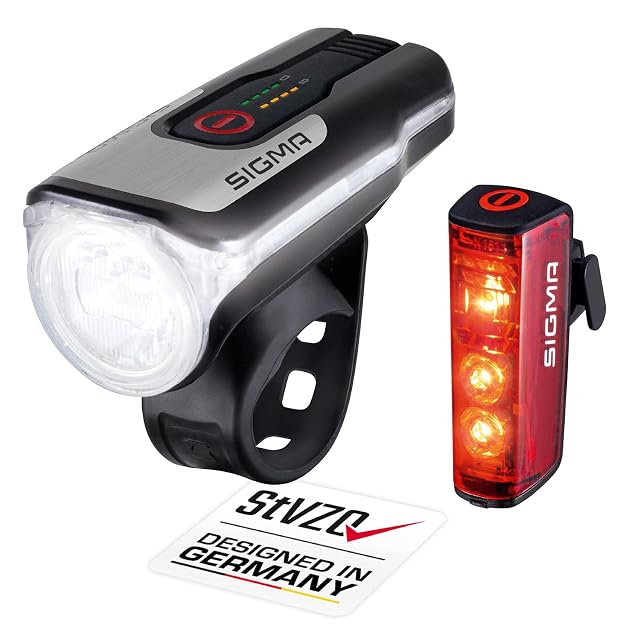
1. SIGMA Aura 80 and BLAZE. Eighty lux at the front, StVZO stated, from a manufacturer that has made lights in Germany for decades. Eighty is more than double every other approved lamp in this catalog, and because the beam has a defined cut-off, that extra output goes onto the road rather than into oncoming faces. On an unlit lane this is not a marginal difference; it is the difference between riding at your usual speed and riding at the speed you can see.
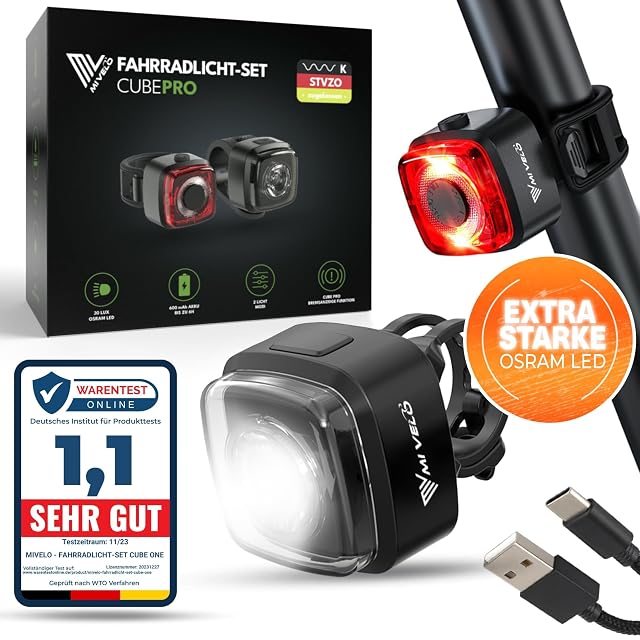
2. MIVELO Cube PRO. Thirty lux front and fifteen rear, IPX5, six hours, and one feature nothing else here offers: the rear lamp brightens under deceleration. On an unlit road the traffic behind you has no other cue that you are slowing. MIVELO does not publish the detection threshold, which is what would tell you how well it works, so we report the feature as stated.
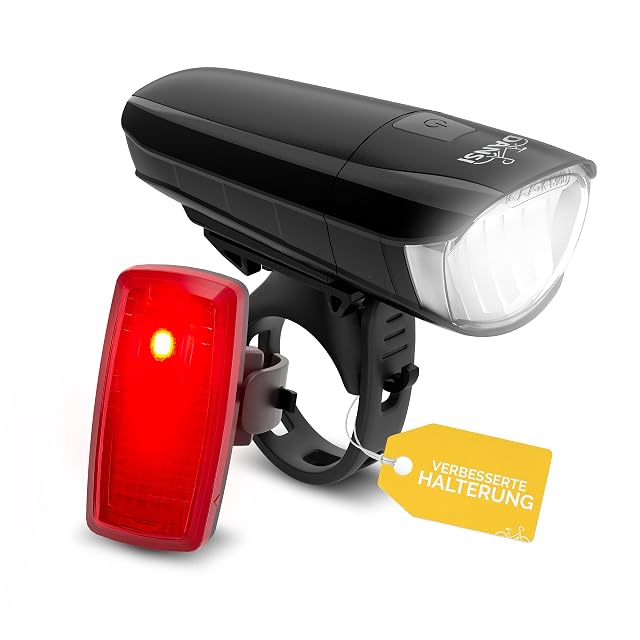
3. DANSI battery set. Thirty and fifteen lux, StVZO stated, six hours front and fifteen rear, on replaceable batteries with a level indicator. The indicator exists because a battery light gives less warning than a rechargeable one. It is the cheapest set here and the best-selling one, and thirty lux is enough to be seen and to read a surface at commuting speed.
What to check before you buy
Mounting diameter, and whether your bars are clear where the bracket goes. And if you ride an unlit route regularly, buy a second rear light — a rear lamp failing is the one you do not notice.
Which one fits how you ride?
You ride on unlit roads
You need a light to see by, which is a different product from a light to be seen by.
You ride in traffic under street lighting
Being seen is the job, and a modest light with a good flash pattern does it.
You ride long distances at night
Runtime at the brightness you actually use is the specification, and it is rarely the headline figure.
You ride where lighting is regulated
Rules on flashing lights, colors and mounting vary by country, and they are worth knowing before you buy.
Picking by how you ride
Seeing the road
Unlit lanes need a beam with real output and, crucially, a shaped beam that puts light on the road rather than into oncoming eyes.
Being seen
Urban riding, where a modest front and rear light plus reflectives do the job.
Long night rides
Where runtime, a battery indicator and the ability to recharge on the move all matter.
Winter commuting
Where cold reduces battery life and where mounting security in rain becomes a real issue.
What really separates these
Beam shape, not just output
A shaped beam that cuts off at the top lights the road without dazzling. A round beam of the same output is worse for everyone, including you.
Runtime at usable brightness
Stated runtimes are usually at the lowest setting. What matters is how long it lasts on the setting you will actually ride with.
Mount security
A light that rattles loose on a rough road is lost. Rubber straps are convenient; bracket mounts are more secure.
Weather sealing
Rain gets into cheap lights through the charging port. A proper seal is what separates a light that lasts a winter from one that does not.
Local regulations
Some countries regulate flashing front lights, light colors and even approval marks. Checking what applies where you ride avoids a fine and a useless purchase.
Which figure for which ride
Where you ride
The light
What matters
Unlit roads
A light to see by
Beam shape and output
Lit streets
A light to be seen by
Visibility from the side
Long night rides
Good runtime
Real-world, not headline
Anywhere
Check local rules
Flashing and colors vary
Where riders go wrong
Buying on output alone
A very bright round beam dazzles oncoming traffic and wastes light in the sky. Beam shape does more for how much road you actually see.
Trusting the stated runtime
It is usually measured on the lowest setting. Plan around the runtime at the brightness you will use, and carry a backup on long rides.
Ignoring side visibility
Most urban collisions involve traffic from the side. Side-visible lights or reflectives matter more than extra forward output.
Mounting the front light too high
A high, unshaped beam dazzles rather than lights the road. Lower and angled down illuminates more of what you need to see.
By the kind of rider you are
The rural night rider
A shaped high-output beam, a spare, and a rear light with good runtime.
The urban commuter
Modest front and rear lights, side visibility, and reflective clothing that costs almost nothing.
The winter rider
Well-sealed lights, secure brackets, and the knowledge that cold shortens every battery.
Servicing and how long it holds up
Bike lights die from water ingress at the charging port and from batteries left flat over winter. Both are avoidable, and a light that has been through a wet winter unsealed is usually beyond saving.
Close the charging port cover properly every time; that is where water gets in.
Store lights part-charged rather than flat over a long break.
Rinse road salt off the body and the mount after winter rides.
Check the mount for cracks; brackets fail before the light does.
Safety
Lights are safety equipment, and the rules around them are real.
Check what your country requires for front, rear, reflectors and flashing modes.
Angle the front beam down so it lights the road and does not dazzle oncoming riders and drivers.
Carry a spare rear light; being unlit from behind is the dangerous failure.
Do not rely on lights alone: reflective material and road position matter too.
Lumens count the total light a lamp emits in every direction. Lux measures how much of it lands on a surface at a given distance. A lamp can be high in lumens and poor on the road if it scatters, which is why approved lamps are specified in lux — and why a lumen figure alone tells you almost nothing about a beam.
What does StVZO mean on a light?
The German road traffic regulations, which define a beam with a sharp upper cut-off so it lights the road without dazzling oncoming traffic. Manufacturers state conformity themselves; we report that statement and do not assess it. A lamp with a cut-off puts a larger share of its output on the road, which is why a brighter approved lamp is a real gain rather than a marketing one.
Battery or rechargeable?
A rechargeable light is cheaper to run and dies when you forget to charge it. A battery light is solved with a shop rather than a charger. For a commute where being caught out has consequences, the battery set is a genuine argument rather than a compromise.
How bright a front light do I need?
For unlit roads, enough to see by, and beam shape matters as much as output. For lit streets, far less than most people buy.
What is a shaped beam?
A beam with a cut-off at the top, so the light goes onto the road rather than into oncoming eyes. It shows you more road for the same output.
Can I use a flashing front light?
Rules vary by country and some regulate or prohibit it. Check what applies where you ride, because it also affects whether a light is legally approved.
Why does my light not last as long as claimed?
Stated runtimes are usually at the lowest setting, and cold reduces battery capacity further. Plan around the setting you actually use.
Do I need side visibility?
In traffic, it matters more than extra forward output, because many urban conflicts involve vehicles approaching from the side.
Why did my light stop working after winter?
Almost always water through the charging port. Closing the cover properly every time is the single thing that prevents it.
Spares and fitting kit from the same aisle, at the price we read. Confirm they match the bike and the part you chose before ordering: it turns on the standard and the part number, which the listing gives.
Bone Bike Tie Pro 4, BK20051-BK · Phone mounts — Stem mount · all silicone, no screws · phones 4.7–7.2" · 65 g (2.3 oz) · 1-year warranty
ALIEN PROS EVA bar tape, set of 2 · Grips and bar tape — 2 rolls · 2 m (7 ft) × 3 cm (1.2 in) × 3 mm (0.12 in) · EVA foam · full adhesive back · 2 end caps
AARON AA-1008-01 · Grips and bar tape — Gel damping · integrated horns · non-slip rubber · ergonomic
The one-sentence call
If your first priority is our rating → look at SIGMA 17860
Comparisons that help
Direct match-ups already published between two picks from this guide or this aisle.
Everything listed is drawn from the catalog of this site. Specifications are the published ones, from the maker and from Amazon; prices are what Keepa recorded on the date shown, and both move. The order rests on declared specifications, on stated strengths against stated limits, and on price. None of this kit has been ridden by us, and the page makes no such claim.
Last checked on
Prices quoted in these summaries are dated readings. The live price is shown next to each product.
The tool we use ourselves
Chosen your tool? Now buy it at the right price.
Bike racks, trainers and computers swing by thirty dollars or more across the year, and
the biggest "discounts" often land at prices the same model sold for six weeks earlier.
UniverTrack tracks the real price history across retailers, spots fake
reductions, and alerts you when it is genuinely the moment to buy.
Real price historyBuy-now alertsAI buying assistant