Every lock listing says hardened steel. The word means nothing on its own, and no manufacturer publishes how long its own lock resists an angle grinder. What can be checked is whether an independent scheme has assessed it — so that is what this list is ordered by.
An independent grading, the length, and what the lock will actually reach around.
Length is the one people underestimate. Eighty-five centimeters sounds generous until it has to pass through a frame, a rear wheel and a stand of the wrong diameter.
The order, and why
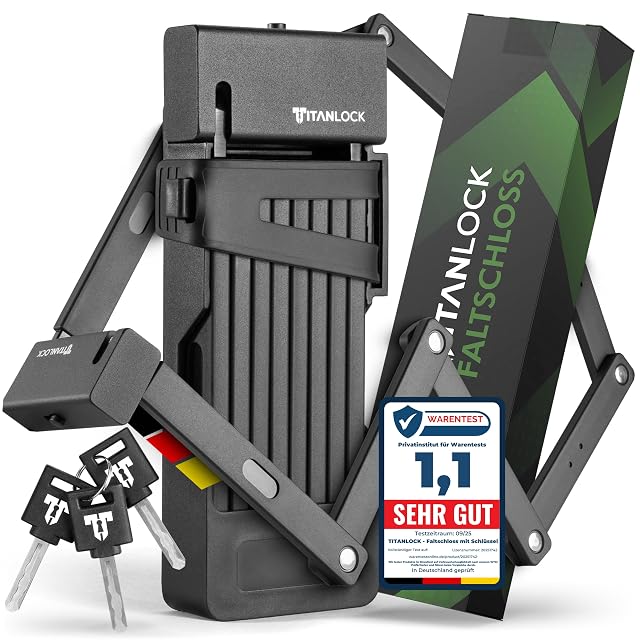
1. TITANLOCK folding lock, 100 cm. ART certification stated, and a hundred centimeters — the longest here — which is what lets it take in the frame, the rear wheel and a thick stand at once. It also has an anti-scratch coating, which matters on a lock that lives folded against a painted frame.
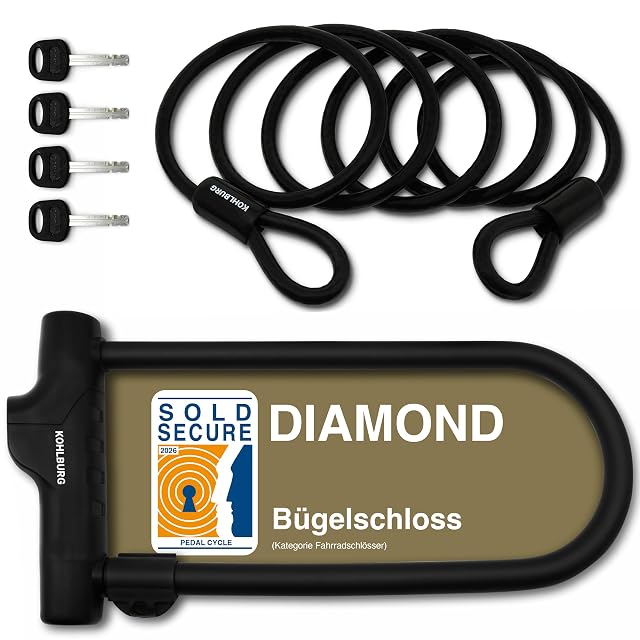
2. KOHLBURG D-lock with cable. A 14 mm shackle, an ADFC recommendation stated, and a 1.7 m cable included. A 17 × 34.3 cm shackle is large enough to reach around most stands, and the cable covers the front wheel — the part most commonly left behind. Two named schemes across the top two locks here, which is two more than most of this category offers.
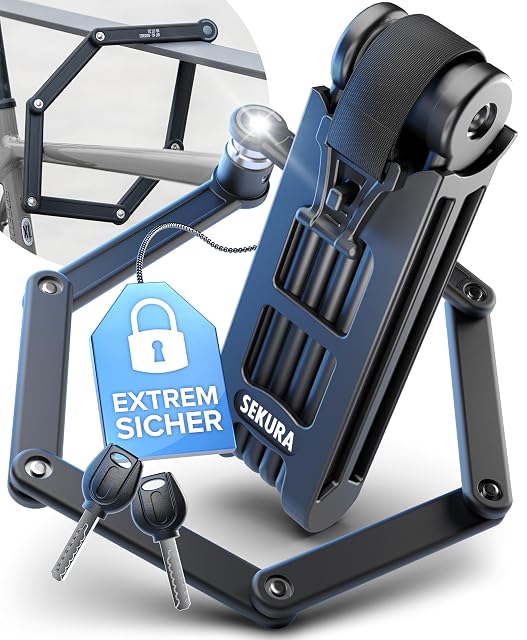
3. Büchel Sekura, 85 cm. The best-selling lock on this site, hardened steel, and three keys rather than two — a sensible detail, since a lost key on a two-key lock leaves you one mistake from a cut lock. It names no independent grading, which is not evidence of weakness but is an absence you should know about if your policy names a scheme.
What to check before you buy
Take a tape to the stand you actually use and measure around the frame, the rear wheel and the stand together. That figure, not the lock’s own dimensions, is what decides whether it closes.
Which one fits how you ride?
You lock up all day in a city
A high-rated D-lock or chain, and the accepted advice of spending a meaningful fraction of the bike's value on the lock.
You stop for five minutes
A lighter lock is a defensible compromise, and it is better than the lock left at home because it was heavy.
You have quick-release wheels
One lock is not enough: either a second lock, a cable, or locking skewers.
Your bike lives outside
Two different lock types, because a thief carrying tools for one may not carry tools for both.
Picking by how you ride
All-day parking
The hardest case. Time and cover are what a thief needs, and a busy well-lit spot is worth as much as a better lock.
Quick stops
Where weight matters most, because a lock you leave at home protects nothing.
Home storage outdoors
Where a ground anchor changes the situation completely, and where the lock is only half of it.
Travel and multi-modal commuting
Where weight and how the lock carries on the bike start to decide which one you actually use.
What really separates these
Its security rating
Independent rating schemes exist and insurers often reference them. A rating from a recognized scheme tells you far more than the description does.
Weight against how far you carry it
Security correlates with weight. A lock too heavy for your route is a lock left at home, which is the worst outcome.
How you lock, not just what with
Frame and rear wheel to an immovable object, filling the shackle so there is no leverage room. Technique changes the result as much as the lock does.
What you can lock to
A proper cycle stand rather than a railing that lifts out or a sign post a bike can be lifted over. This is the most overlooked part.
Insurance requirements
If your bike is insured, the policy may specify a lock rating. Buying below it can void a claim, which makes it the first thing to check.
Which figure for which ride
Your situation
The lock
The extra
All-day city parking
High-rated D-lock or chain
A second lock for the wheel
Five-minute stops
A lighter lock
Nothing
Bike stored outside
Two lock types
A ground anchor
Insured bike
The rating the policy names
Keeping the receipt
Where riders go wrong
Locking only the frame
A quick-release wheel comes off in seconds. Frame and rear wheel to the stand, or a second lock or cable for the front.
Leaving leverage room in the shackle
A D-lock with a large gap can be levered. Filling the space with the bike and the stand removes the easiest attack.
Locking to something that lifts
A railing that unbolts, a post with nothing on top, a small tree. The lock is irrelevant if the anchor is not.
Buying below your insurer's requirement
A policy that names a rating means a claim can be refused if the lock is below it. It costs nothing to check first.
By the kind of rider you are
The city commuter
A high-rated D-lock plus a cable or second lock, and a habit of locking to proper stands.
The occasional rider
A lighter lock they will actually carry, used for short stops in visible places.
The one with an expensive bike
Two locks, a ground anchor at home, insurance, and the acceptance that a bike left in the street overnight is at real risk.
Servicing and how long it holds up
Locks fail from corrosion in the mechanism, and a lock that has become stiff is a lock that will eventually refuse to open with the bike attached to it. Cheap keys also wear and snap in the barrel, which is a bad day.
Lubricate the barrel with a suitable lock lubricant, not general oil which attracts grit.
Keep the keyway pointed down or covered when locked outside; water sits in it and freezes.
Replace a key that has started to bend before it snaps in the lock.
Register the lock with the maker if they offer a key replacement service.
Safety
This section is about the bike rather than about you.
Record the frame number and photograph the bike; both matter enormously if it is stolen.
Register the frame number with a national database where one exists.
Lock in busy, overlooked places rather than quiet corners, whatever lock you have.
100 cm (39.4 in) folding · ART certification stated · anti-scratch
A 100 cm (39.4 in) folding lock whose manufacturer states ART certification, with a protected cylinder intended to resist drilling and an anti-scratch coating on the links.
Best for: City riders whose insurer names a certification scheme, or who park a valuable bike in the same place regularly.
14 mm (0.55 in) shackle · ADFC recommendation stated · 1.7 m (6 ft) cable
A large D-lock with a 14 mm (0.55 in) hardened shackle and an ADFC recommendation stated by the manufacturer, supplied with a 1.7 m (6 ft) cable for the front wheel and accessories.
Best for: Anyone leaving a bike in a city where theft is a real prospect, and who is prepared to carry the weight.
85 cm (33.5 in) hardened steel · 3 keys · bracket included
A hardened steel folding lock at 85 cm (33.5 in) from a long-established German bicycle parts maker, supplied with three keys and a frame bracket, and the best-selling lock in this hub.
Best for: Everyday city parking where a serious deterrent matters more than a certified grading.
A Dutch independent testing foundation that grades locks by how long they resist a defined set of attacks. A manufacturer stating ART certification is making a checkable claim about a third-party assessment, which is different in kind from stating that its steel is hardened. We report the claim; we do not verify certificates.
Does my insurer specify a lock?
Many do, by naming a scheme and a grade rather than a brand. Read your own policy before you buy — an uncertified lock can void a claim regardless of how solid it is.
Folding lock or D-lock?
A folding lock wraps around more shapes and packs flat on the frame. A D-lock has fewer joints, and joints are where a folding lock is attacked. The honest answer is that a D-lock plus a cable secures a wheel as well, which is what the KOHLBURG here is.
How much should I spend on a lock?
Common advice is a meaningful fraction of the bike's value. The more useful rule is to buy to the rating your insurer requires, if the bike is insured.
D-lock or chain?
A D-lock is lighter and easier to carry; a chain is more flexible about what you can lock to. Many city riders end up with one of each.
Do I need two locks?
For all-day parking, generally yes: two different types mean a thief needs two sets of tools. It also secures the wheels.
What should I lock to?
A proper cycle stand fixed to the ground. Railings that unbolt, posts with open tops and small trees are all defeated without touching the lock.
Does lock rating matter for insurance?
Often decisively. Many policies name a minimum rating, and a claim can be refused if the lock used was below it.
My lock has become stiff. What now?
Corrosion in the barrel. Use a proper lock lubricant rather than general oil, and act before it seizes with the bike attached.
Spares and fitting kit from the same aisle, at the price we read. Confirm they match the bike and the part you chose before ordering: it turns on the standard and the part number, which the listing gives.
FUCNENbksc-55-blkzx036 · Frame protection and saddle covers — 29 × 27 cm (11.4 × 10.6 in) · silicone gel padding · non-slip underside
Kasanni zt-lh59 · Frame protection and saddle covers — 2 covers · PVC · under 30 g (1.1 oz) · elastic hem
CLIFFORD S-20-HLS · Rack straps and frame adapters — 50 mm (1.97 in) wide · 40–100 cm (15.7 to 39.4 in) adjustable · metal eyelet · silicone anti-slip
Allen 900B · Rack straps and frame adapters — 53.3 × 15.2 × 3.6 cm (21 × 6 × 1.4 in) · for 46–68 cm (18.1 to 26.8 in) bar-to-saddle · internal spring · coated hooks · $25
The one-sentence call
If your first priority is the price → look at Büchel 60503853
Everything listed is drawn from the catalog of this site. Specifications are the published ones, from the maker and from Amazon; prices are what Keepa recorded on the date shown, and both move. The order rests on declared specifications, on stated strengths against stated limits, and on price. None of this kit has been ridden by us, and the page makes no such claim.
Last checked on
Prices quoted in these summaries are dated readings. The live price is shown next to each product.
The tool we use ourselves
Chosen your tool? Now buy it at the right price.
Bike racks, trainers and computers swing by thirty dollars or more across the year, and
the biggest "discounts" often land at prices the same model sold for six weeks earlier.
UniverTrack tracks the real price history across retailers, spots fake
reductions, and alerts you when it is genuinely the moment to buy.
Real price historyBuy-now alertsAI buying assistant