A cordless inflator earns its price by covering bikes and a car from one device. What decides whether it does is three published figures — the pressure ceiling, the number of tires per charge, and how low the preset cut-off goes, because a mountain bike tire lives at two bar and a car tire at two and a half.
The published figures, and where the adapters live.
The order, and why
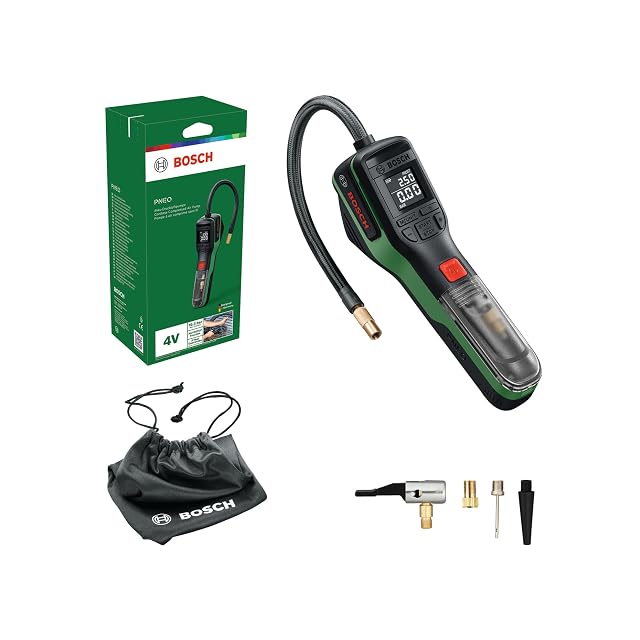
1. Bosch PNEO. Ten point three bar with real-time measurement and auto-stop, and the adapters stored inside the tool handle. Two arguments put it first. The adapter storage, because every inflator ships adapters in a small bag that is lost within a year and a unit with a lost Presta adapter is useless for road bikes. And the manufacturer, because this is a category dominated by brands that appear and vanish — a failed battery or a broken hose on an unknown brand means a new unit rather than a spare.
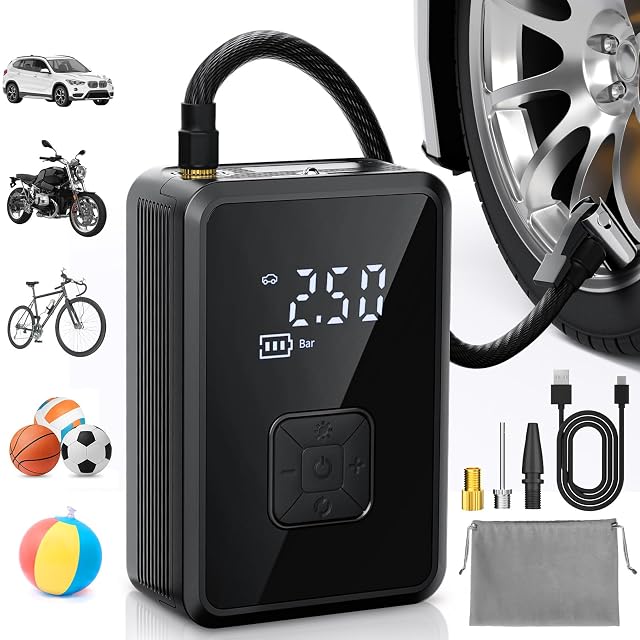
2. Oasser cordless inflator. The most complete set of figures in this hub: 10.3 bar, a road tire in 86 seconds, four modes spanning 0.2 to 10.3 bar, and up to ten tires per charge. A 0.2 bar floor is the lowest here, which is what makes it usable on wide tires where the others bottom out.
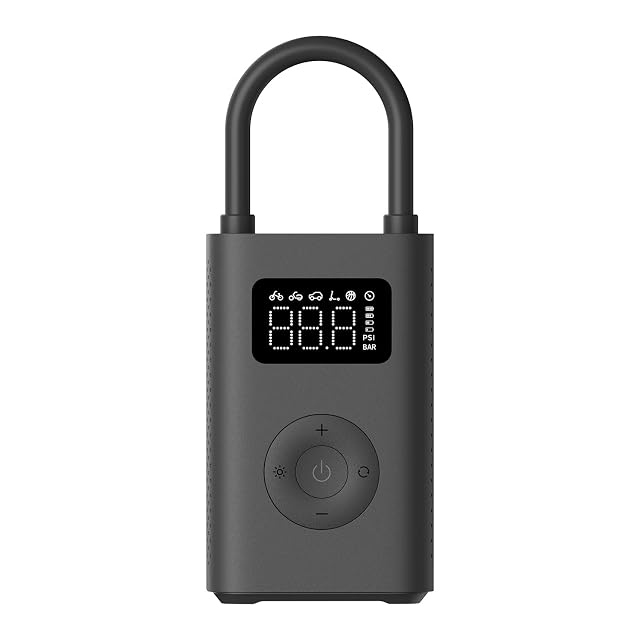
3. XIAOMI Portable Electric Air Compressor 2. A hundred and fifty psi ceiling, up to ten tires per charge, and a 19 mm die-cast cylinder. The 19 mm cylinder is optimized for pressure rather than volume, so a 2.4 inch mountain bike tire takes noticeably longer than a road tire — a design trade rather than a fault, and worth knowing before you buy it for a mountain bike.
What to check before you buy
The lowest preset the unit accepts, against the lowest pressure you actually run. That single comparison decides more of this than the maximum on the box.
Which one fits how you ride?
You inflate bike and car tires
A cordless inflator that handles both saves owning two things and a garage trip.
You only pump bikes at home
A track pump is faster, quieter and needs no charging.
You want it in the car
Battery capacity and how long it holds charge unused become the real specification.
You run tubeless
Most cordless inflators cannot seat a tire; they top up, which is a different job.
Picking by how you ride
Topping up car tires
Where these are genuinely convenient, and where the preset pressure and automatic cut-off do the work.
Bike tires at home
Possible, though a track pump is faster on a bike and never needs charging.
Emergencies away from home
Where having one in the boot is worth the whole purchase, provided it holds charge unused.
Toys and sports balls
Where the adapters make it a household tool, which is often how it earns its place.
What really separates these
Whether it holds charge unused
An inflator kept in a car for emergencies must still work months later. Self-discharge is the specification nobody publishes and everybody discovers.
Preset pressure and auto cut-off
The feature that makes these worth having. Setting a pressure and walking away is what a track pump cannot do.
Maximum pressure and speed
High pressure for road bike tires and volume for car tires are different demands. Check both if you need both.
Noise and heat
Small compressors are loud and get hot. Duty cycle limits are real, and inflating four car tires in a row may exceed them.
Battery type
Some take the same battery as a cordless tool range, which is a considerable advantage if you already own one.
Which figure for which ride
Your use
What matters
The limit
Car tires
Preset pressure and volume
Duty cycle and heat
Bike tires at home
Maximum pressure
A track pump is faster
Kept in the car
Holding charge unused
Batteries self-discharge
Tubeless seating
Not this tool
Needs a burst, not a trickle
Where riders go wrong
Expecting it to seat a tubeless tire
These deliver a steady trickle rather than a burst. Seating a tubeless tire generally needs a charging chamber or a compressor.
Running it continuously
Small compressors have duty cycle limits and get hot. Inflating four car tires without pauses is how they fail.
Leaving it flat in the car for months
An emergency tool that is flat is not a tool. Charging it periodically is part of owning one.
Trusting the gauge without checking
Built-in gauges vary. Comparing once against a known gauge tells you whether to trust it.
By the kind of rider you are
The car and bike household
A cordless inflator with preset pressure, kept charged, plus a track pump for bikes at home.
The cyclist only
A track pump. It is faster, quieter and always ready.
The cordless tool owner
An inflator on the same battery platform, which removes the charging problem entirely.
Servicing and how long it holds up
Cordless inflators are small compressors with a lithium battery, and both parts age. Heat is what kills the compressor and long periods flat are what kill the battery, and neither is a fault when it happens.
Let it cool between tires rather than running it continuously.
Recharge it periodically even when unused; that is what keeps an emergency tool useful.
Keep the air intake clear of dust.
Store it out of extreme heat and cold, which the boot of a car is not.
Safety
Compressed air, a hot motor and a lithium battery.
Never exceed the pressure marked on the tire sidewall.
Let the unit cool between uses; the housing gets genuinely hot.
Do not charge or store a damaged or swollen battery.
Keep hands clear of the tire bead while inflating a freshly fitted tire.
10.3 bar · road tire in 86 s · 4 modes 0.2–10.3 bar · 10 tires per charge
The most completely specified inflator in this hub: 10.3 bar, a road tire in a stated 86 seconds, four modes down to 0.2 bar and up to ten tires per charge.
Best for: Anyone who wants to know exactly what they are buying — this is the best-documented inflator here.
150 psi · 19 mm (0.75 in) die-cast cylinder · 25% faster stated · up to 10 tires
A compact compressor with a 19 mm (0.75 in) die-cast cylinder supporting up to 150 psi, a magnetic motor the maker states is 25% faster, and up to ten tires per charge.
Best for: A household compressor with the pressure headroom for road tires and the capacity for a car.
Bicycle tires run from roughly 1.8 bar on a wide mountain bike tire to 8 bar on a narrow road tire, and the range is printed on the sidewall. Car tires are around 2.2 to 2.8 bar. Every inflator here reaches well past all of it, so the ceiling is rarely the deciding figure.
Why does the cut-off matter more than the maximum?
Because the useful feature is walking away. Set a target, and the unit stops there rather than needing you to watch a gauge. The figure to check is the lowest preset it will accept — a unit that cannot be set below 2 bar is no use for a wide mountain bike tire.
Does it work on a Presta valve?
Every unit here ships with adapters, and the Presta adapter is a small brass fitting that screws on. It is also the piece that gets lost, which is why the Bosch storing its adapters inside the handle is worth more than it sounds.
Can a cordless inflator replace a track pump?
For convenience yes, for speed on a bike no. A track pump is quicker on bike tires and never needs charging.
Will it seat a tubeless tire?
Generally not. Seating needs a sudden burst of air, and these deliver a steady flow. A charging chamber or compressor is the right tool.
Will it still work if I leave it in the car?
Only if you recharge it periodically. Batteries self-discharge, and an emergency tool that is flat is not a tool.
Can I inflate four car tires in a row?
Often not without pauses. Small compressors have duty cycle limits and running them continuously is how they overheat.
Is the built-in gauge accurate?
It varies. Comparing it once against a gauge you trust tells you whether you can rely on it.
Spares and fitting kit from the same aisle, at the price we read. Confirm they match the bike and the part you chose before ordering: it turns on the standard and the part number, which the listing gives.
Bell 1001999 · Inner tubes — 26" × 1.75-2.25 · Schrader 35 mm (1.38 in) · mold-cured · $7.99
Everything listed is drawn from the catalog of this site. Specifications are the published ones, from the maker and from Amazon; prices are what Keepa recorded on the date shown, and both move. The order rests on declared specifications, on stated strengths against stated limits, and on price. None of this kit has been ridden by us, and the page makes no such claim.
Last checked on
Prices quoted in these summaries are dated readings. The live price is shown next to each product.
The tool we use ourselves
Chosen your tool? Now buy it at the right price.
Bike racks, trainers and computers swing by thirty dollars or more across the year, and
the biggest "discounts" often land at prices the same model sold for six weeks earlier.
UniverTrack tracks the real price history across retailers, spots fake
reductions, and alerts you when it is genuinely the moment to buy.
Real price historyBuy-now alertsAI buying assistant