Mudguards are the single change that makes winter commuting tolerable, and the reason people go without is usually that their frame has no mounting eyelets. This list covers both cases, and finishes with the part that is a legal requirement in much of Europe and costs a couple of euros.
Coverage, and whether your frame can take a full-length guard at all.
Full-length guards run from just behind the bottom bracket to well down the back of the rear wheel, and they keep the spray off you, off the bike and off whoever is riding behind. Clip-on guards cover perhaps half of that. The difference shows up as a wet stripe up your back.
The order, and why
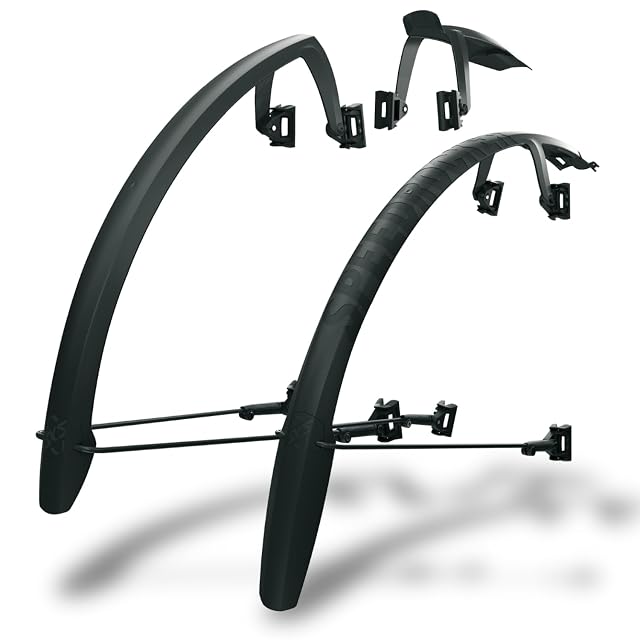
1. SKS SPEEDROCKER, 28 inch. A front and rear set for gravel and road, made in Germany, from the manufacturer this category is built around. It is first because it is a proper set rather than a pair of flaps, and because SKS parts are still available years later — which matters on a component whose usual failure is a broken stay rather than a broken guard. SKS states a wheel size and not a tire clearance figure, which is the specification you actually need, so ask the seller for it.
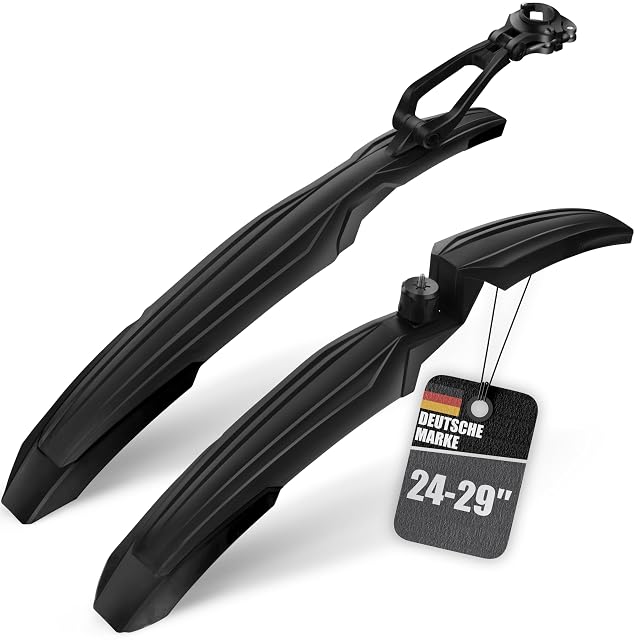
2. BALOU MTB mudguard set, 24–29 inch. Front and rear, clip-on, explicitly needing no eyelets, across a 24 to 29 inch range. This is the answer for a frame that cannot take a bolted guard, and the wide size range means one set covers most of a household. Less coverage than a full-length guard, and nothing else fits.
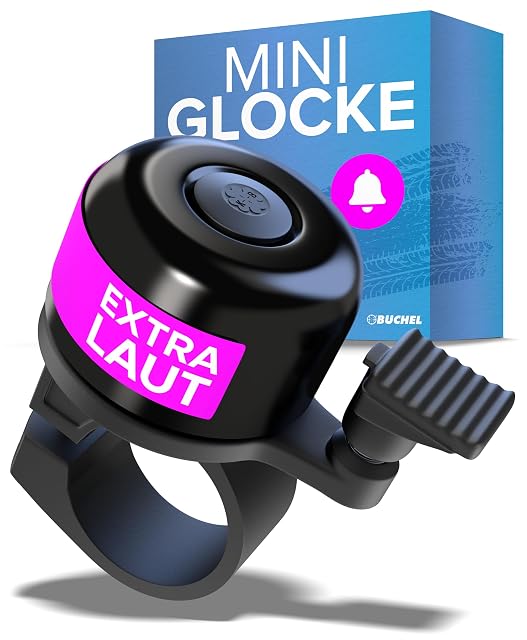
3. Büchel mini bell, 35 mm. Up to 100 dB, fitting 21.8 and 28 mm bars with the supplied rubber inserts, rotating 360°. It is the cheapest item on this entire site and in several countries it is not optional. Two bar diameters covered rather than one is the detail worth having, because flat bars are commonly 22.2 mm at the grips.
What to check before you buy
Measure the gap between your tire and the underside of the fork crown, and between the tire and the seatstay bridge. Those two gaps, not the wheel size, decide whether a full-length guard goes on.
Which one fits how you ride?
Your bike has mudguard mounts
Full-length guards are far more effective and quieter than clip-on ones.
Your bike has no mounts
Clip-on guards exist and work reasonably, and a seatpost guard is better than nothing.
You ride with others
A rear flap that reaches low is the difference between being welcome in a group and not.
You have limited tire clearance
Measure before buying: guards need real clearance and a rubbing guard is a daily annoyance.
Picking by how you ride
Winter commuting
The main case. Guards keep the spray off you, your bag and the bike's bearings, and that last one is underrated.
Group riding
Where the rear guard and its flap are a courtesy rather than a comfort, and where clubs often require them.
Occasional wet rides
Where clip-on guards make sense because they come off for the summer.
Off-road
A different product entirely: short guards that stop face-height spray without clogging with mud.
What really separates these
Tire clearance
Guards need space around the tire. Measuring the gap before buying prevents the commonest disappointment and the commonest rub.
Mounting points
Eyelets on the frame and fork make full-length guards straightforward. Without them, clip-on designs are the answer.
Coverage, especially the rear flap
A rear guard that stops high still sprays the rider behind. A long flap is what actually keeps a group happy.
Rattle and fixing quality
Cheap guards rattle and then crack. Solid stays and rubber-damped fixings are the difference between an asset and an irritation.
A safety release on the front
Front guards should break away if something jams between guard and tire. This is a real safety feature, not a marketing one.
Which figure for which ride
Your bike
The guards
The check
Has mudguard eyelets
Full-length guards
Tire clearance
No eyelets
Clip-on guards
How securely they mount
Group riding
Long rear flap
Club requirements
Off-road
Short spray guards
Mud clearance
Where riders go wrong
Buying without measuring clearance
Guards need real space around the tire. Too tight and they rub constantly, which is both irritating and a wear point.
Fitting a rear guard that stops short
It keeps you dry and sprays everyone behind. A long flap costs almost nothing and is the difference in a group.
Ignoring the front safety release
A stick or a stone jammed between guard and tire can lock the front wheel. Break-away fittings exist precisely for that.
Living with a rattle
A rattling guard is a guard whose fixings are loosening. It will crack eventually, and tightening it early prevents that.
By the kind of rider you are
The winter commuter
Full-length guards with a long rear flap, fitted properly and checked for rubbing.
The occasional wet rider
Clip-on guards that go on in November and come off in March.
The group rider
Whatever the club requires, which is usually full guards with a flap that reaches low.
Servicing and how long it holds up
Mudguards loosen, and a loose guard rattles and then cracks at a stay. Winter grit also builds up between guard and tire, which is where the rubbing starts.
Tighten the stays periodically; vibration loosens them constantly.
Clear grit from between the guard and the tire after wet rides.
Check the front break-away fittings still work as intended.
Replace a cracked guard rather than taping it; cracks spread at the stay.
Safety
A guard that jams a wheel is a serious hazard.
Use front guards with a break-away or safety-release fitting.
Check clearance regularly, especially after fitting different tires.
Investigate any new rubbing noise rather than ignoring it.
Make sure guards cannot foul the brakes or the tire when the fork compresses.
Tire clearance, not wheel size. A guard has to clear the tire by a few millimeters across its full width, and the figure that matters is the gap between your tire and the frame or fork. Wheel size tells you the guard's radius; clearance tells you whether it goes in.
What if my frame has no eyelets?
Clip-on guards mount to the seatpost and fork legs with straps or clamps rather than to threaded eyelets. They cover less than a full-length guard and they go on any frame, which is the trade.
Is a bell legally required?
In several European countries, yes, and the requirement is national. Germany and the Netherlands are among those requiring one. Check the rules for where you ride — they are set by road traffic law rather than by anything a manufacturer states.
Do I need full-length mudguards?
For winter commuting they are far more effective than clip-ons, and they protect the bike's bearings as well as you. They need mounting eyelets and clearance.
My bike has no mudguard mounts. What can I fit?
Clip-on guards, which mount to the seatpost, fork and frame tubes. They cover less but they are a real improvement over nothing.
How long should the rear flap be?
Long enough that the spray goes onto the road rather than onto the rider behind. Many clubs specify this, and it is the courtesy that matters in a group.
Why does my mudguard rub?
Usually clearance, a loose stay, or grit packed between guard and tire. All three are worth fixing rather than living with.
What is a safety release on a front guard?
A fitting that lets the guard break away if something jams between it and the tire. It prevents the front wheel locking, which is a genuine hazard.
Do mudguards slow me down?
Marginally, and far less than riding in soaked clothing does. For commuting the trade is not close.
Spares and fitting kit from the same aisle, at the price we read. Confirm they match the bike and the part you chose before ordering: it turns on the standard and the part number, which the listing gives.
ALIEN PROS EVA bar tape, set of 2 · Grips and bar tape — 2 rolls · 2 m (7 ft) × 3 cm (1.2 in) × 3 mm (0.12 in) · EVA foam · full adhesive back · 2 end caps
AARON AA-1008-01 · Grips and bar tape — Gel damping · integrated horns · non-slip rubber · ergonomic
CLIFFORD S-20-HLS · Rack straps and frame adapters — 50 mm (1.97 in) wide · 40–100 cm (15.7 to 39.4 in) adjustable · metal eyelet · silicone anti-slip
Allen 900B · Rack straps and frame adapters — 53.3 × 15.2 × 3.6 cm (21 × 6 × 1.4 in) · for 46–68 cm (18.1 to 26.8 in) bar-to-saddle · internal spring · coated hooks · $25
Everything listed is drawn from the catalog of this site. Specifications are the published ones, from the maker and from Amazon; prices are what Keepa recorded on the date shown, and both move. The order rests on declared specifications, on stated strengths against stated limits, and on price. None of this kit has been ridden by us, and the page makes no such claim.
Last checked on
Prices quoted in these summaries are dated readings. The live price is shown next to each product.
The tool we use ourselves
Chosen your tool? Now buy it at the right price.
Bike racks, trainers and computers swing by thirty dollars or more across the year, and
the biggest "discounts" often land at prices the same model sold for six weeks earlier.
UniverTrack tracks the real price history across retailers, spots fake
reductions, and alerts you when it is genuinely the moment to buy.
Real price historyBuy-now alertsAI buying assistant