Carbon components carry a torque figure printed on them, usually between four and six newton meters, and both directions of getting it wrong are expensive: too tight crushes the part, too loose lets a bar rotate under load. What matters in a wrench for this job is not its ceiling but its floor.
The lowest setting, the accuracy at that setting, and whether it tells you when to stop.
A wrench rated from 5 Nm set to 5 Nm is working at the very bottom of its range, where every mechanical torque wrench is least accurate. A wrench that starts at 2 or 2.5 Nm has real margin at the figure you actually need.
The order, and why
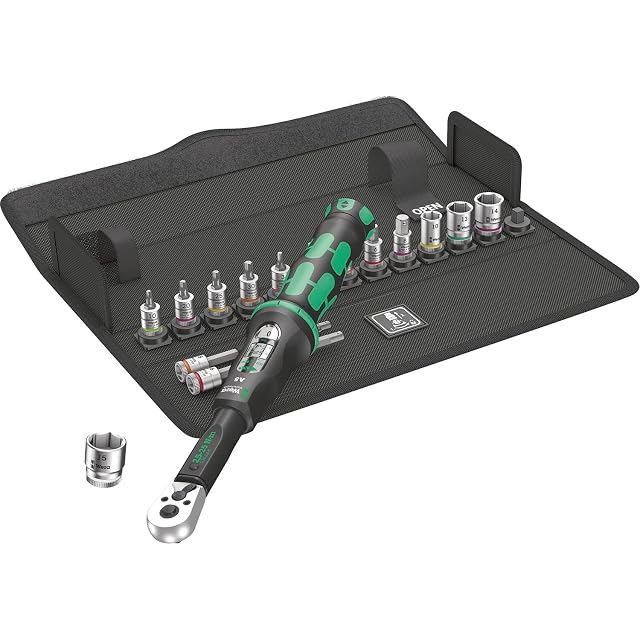
1. Wera Bicycle Set Torque 1. Two point five to twenty-five newton meters with an audible and tactile click, in a sixteen-piece set. Five newton meters sits comfortably inside that range rather than at its edge, and the click means you can torque a stem bolt you cannot see. It is the most expensive answer and it is the right one for carbon.
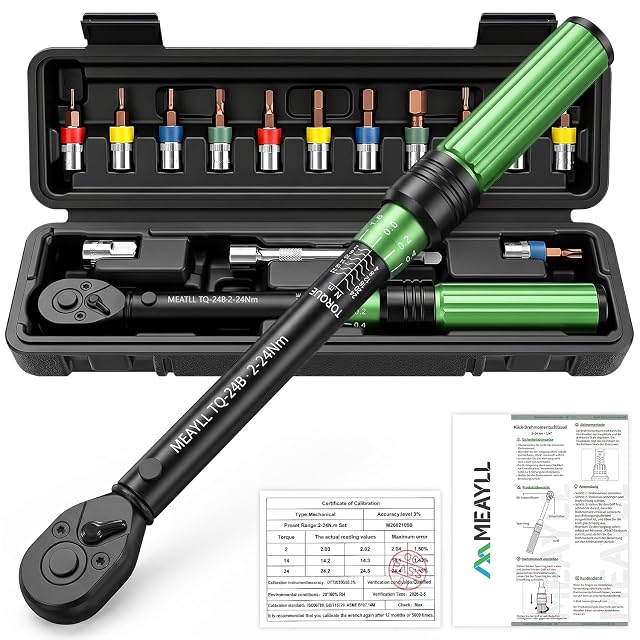
2. Meayll torque wrench set. Two to twenty-four newton meters, stated ±3%, in 0.2 Nm increments, 1/4 inch drive, fifteen pieces. The lowest floor here and the tightest stated tolerance, in increments fine enough to hit 4.5 Nm exactly. On specification it matches the Wera at a fraction of the price; it is second because the Wera’s click mechanism is what the category is built on.
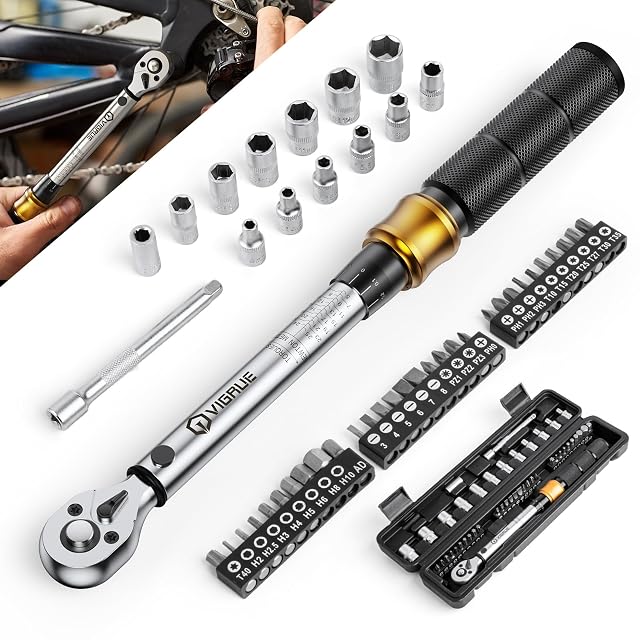
3. VIGRUE torque wrench set. Five to twenty-five newton meters, stated ±4%, with thirty bits, twelve sockets and a case. The most complete accessory set here and the best value if your work is stems, cranks and cassettes. It is third for one specific reason: a 5 Nm floor means a 5 Nm carbon bolt is set at the very bottom of the scale, and a 4 Nm bolt is out of range entirely.
What to check before you buy
Read the printed figure on your own components first. If the lowest one is 4 Nm, the VIGRUE is not the wrench for that job regardless of what else it does well.
Which one fits how you ride?
You own carbon components
A torque wrench is not optional: over-tightening crushes carbon and under-tightening lets it slip.
You work on your own bike
The low-torque range is the one that matters, because that is where stems, seatposts and levers live.
You want one tool
A preset or small adjustable wrench in the low range covers most bicycle fasteners.
You only ride
A shop can do the jobs that need torque, and a multi-tool covers roadside adjustments.
Picking by how you ride
Stem and handlebar bolts
The classic case, and where over-tightening a carbon bar has consequences you find out about at speed.
Seatpost clamps
Where a slipping post and a crushed post are two failures caused by the same missing tool.
Disc rotor and caliper bolts
Where torque matters for a different reason: brakes.
Roadside adjustment
Where a multi-tool is what you carry, and where a rough calibration by feel is all you have.
What really separates these
The torque range you need
Bicycle fasteners are mostly low torque. A wrench designed for car work reads badly at the low end and is the wrong tool.
Preset or adjustable
Preset tools fix one value and are simple and cheap; adjustable ones cover a range and need setting each time.
Click, beam or digital
Click types are the common choice and need resetting to the lowest value for storage; beam types never go out of calibration; digital ones need batteries.
Bit selection
Hex, Torx and the specific sizes your bike uses. A wrench without the right bit is a wrench that does not fit anything.
The torque values themselves
They are printed on the component or in the manual. Guessing them defeats the entire purpose of owning the tool.
Which figure for which ride
The job
What you need
The consequence of getting it wrong
Carbon bar in a stem
Low-range torque wrench
A crushed or cracked bar
Carbon seatpost
Low-range torque wrench
Slipping or crushing
Brake caliper bolts
Torque wrench
Brake failure
Roadside tweak
A multi-tool
Re-check at home
Where riders go wrong
Using a car torque wrench on a bike
Its low end is inaccurate, and bicycle fasteners live entirely at the low end. It is the wrong instrument for the job.
Guessing the torque value
Values are printed on components or given in manuals. A torque wrench used with a guessed number is a normal wrench.
Storing a click wrench at its setting
Click wrenches should be wound back to their lowest setting for storage. Leaving them loaded shortens their accuracy life.
Forgetting assembly paste on carbon
Carbon assembly compound increases grip so less clamping force is needed. Without it, riders tend to over-tighten to stop slipping.
By the kind of rider you are
The carbon bike owner
A low-range torque wrench with the bits their bike uses, plus carbon assembly paste.
The home mechanic
One adjustable low-range wrench and the manuals for their components.
The rider who does not wrench
A multi-tool for the roadside and a shop for anything torque-critical.
Servicing and how long it holds up
Torque wrenches are precision instruments that drift, and a click wrench dropped on a hard floor should be treated as suspect. Storage at the lowest setting is what preserves the spring, and calibration is a service rather than a self-check.
Wind a click wrench back to its lowest setting before storing it.
Do not use a torque wrench to undo fasteners; it is a tightening instrument.
Keep it in its case rather than loose in a toolbox.
Have it calibrated if you rely on it for anything critical, or replace it if it has been dropped.
Safety
These fasteners hold your handlebars and brakes.
Use the value printed on the component, and if there is none, find the manual.
Check stem, bar and seatpost bolts periodically, especially on carbon.
Inspect carbon for cracks after any crash and do not ride a component you are unsure about.
Never exceed the stated torque on carbon; it crushes rather than stretches.
2.5–25 Nm Click-Torque A 5 · 16 pieces · audible and tactile click
A sixteen-piece set built around Wera's Click-Torque A 5 wrench covering 2.5 to 25 Nm, with sockets and bit sockets for the common fastener profiles on road, mountain and e-bikes.
Best for: Someone who works on several bikes, or who wants one tool bought once and not replaced.
Printed on the component itself, next to the bolt, on most carbon bars, stems and seatposts — and in the manufacturer's manual otherwise. Use the figure on your own part. Nothing on this site derives a torque figure, and a figure for a similar part from another maker is not a substitute.
What does a click wrench actually do?
It releases audibly and perceptibly at the set value so you stop, rather than showing a reading you have to watch. On a bolt in an awkward position, being told rather than having to look is the whole point.
Is a stated accuracy of ±3% or ±4% enough?
For bicycle work, comfortably. At 5 Nm, ±4% is ±0.2 Nm. The larger real-world error is a wrench used outside its calibrated range, which is why the lowest setting matters more than the tolerance.
Do I really need a torque wrench for carbon?
Yes. Carbon crushes rather than deforms, so over-tightening damages it and under-tightening lets it slip. There is no safe way to judge by feel.
What torque range should I buy?
A low range, because bicycle fasteners live there. A car torque wrench reads poorly at the low end and is the wrong tool.
Preset or adjustable?
Preset is simple and cheap for one or two common values; adjustable covers everything and needs setting each time. Both are legitimate.
Where do I find the torque value?
Printed on the component itself or in its manual. If neither exists, ask the manufacturer rather than guessing.
What is carbon assembly paste?
A compound that increases friction between clamped surfaces, so the same grip is achieved at lower torque. It reduces the temptation to over-tighten.
How do I store a click wrench?
Wound back to its lowest setting, in its case. Leaving it loaded shortens the useful accuracy of the spring.
Spares and fitting kit from the same aisle, at the price we read. Confirm they match the bike and the part you chose before ordering: it turns on the standard and the part number, which the listing gives.
corki CB001-21 · Cables and housing — 4 mm (0.16 in) linear strand housing · 2 × 1.1 mm (0.08 × 0.04 in) stainless PVC · 2,100 mm (82.7 in) · 121 g (4.3 oz)
Jagwire CEX, 5 mm × 50 ft · Cables and housing — 5 mm (0.20 in) · spiral-wound brake housing · 15.2 m (50 ft) · 30 end caps · 907 g (32 oz)
Everything listed is drawn from the catalog of this site. Specifications are the published ones, from the maker and from Amazon; prices are what Keepa recorded on the date shown, and both move. The order rests on declared specifications, on stated strengths against stated limits, and on price. None of this kit has been ridden by us, and the page makes no such claim.
Last checked on
Prices quoted in these summaries are dated readings. The live price is shown next to each product.
The tool we use ourselves
Chosen your tool? Now buy it at the right price.
Bike racks, trainers and computers swing by thirty dollars or more across the year, and
the biggest "discounts" often land at prices the same model sold for six weeks earlier.
UniverTrack tracks the real price history across retailers, spots fake
reductions, and alerts you when it is genuinely the moment to buy.
Real price historyBuy-now alertsAI buying assistant