Six spare valve cores, which is six services saved
Thinvik Injector kit, 100 ml, 6 valve cores
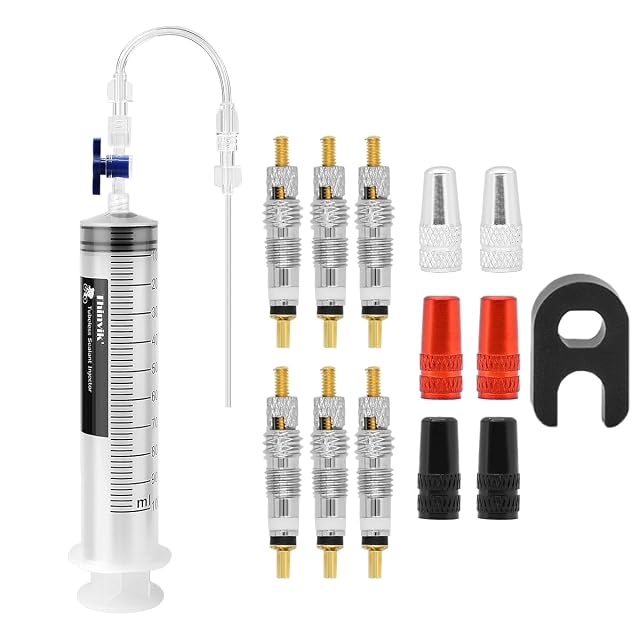
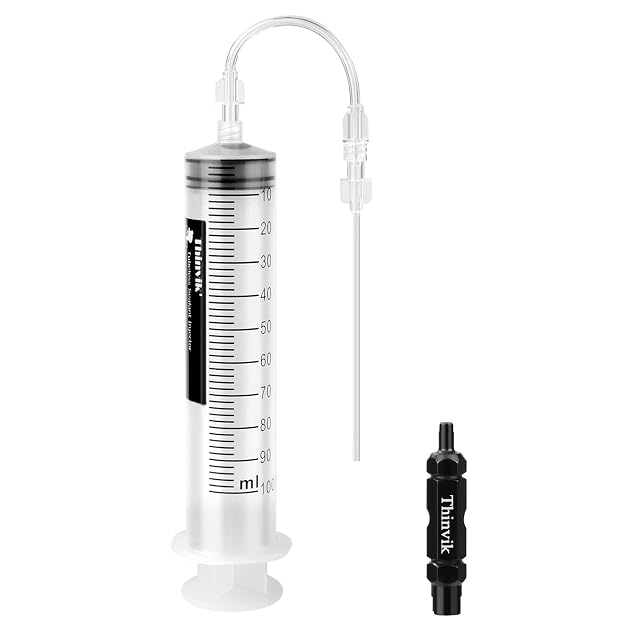
A 100 ml tubeless sealant injector with a 200 mm (7.87 in) hose and switch, a core removal tool and six nickel-plated spare valve cores.
What you are getting
A 100 ml sealant injector with a 200 mm (7.87 in) hose and an on-off switch, a CNC valve core remover, six spare valve cores and six valve caps in three colors. $13.99.
It is the most complete injector kit on this page
Four items where the others have one or two:
| injector | hose | core tool | spare cores |
|---|
| This kit | 100 ml | 200 mm (7.87 in), with switch | yes | 6 |
| Thinvik plain | 100 ml | 200 mm (7.87 in) | yes | no |
| Park Tool TSI-1 | 100 cc, gauged | not published | no | no |
| SILCA | 59 ml | yes | no | no |
Six spare cores is the part that is easy to undervalue. A valve core is a brass insert that is unscrewed every time sealant is injected, and it is the part that corrodes shut in dried latex — at which point the only way back in is breaking the bead, which is exactly what the buying advice on this shelf says to avoid.
Six cores is six services where a seized one does not stop the job.
The switch is the practical difference from the plain Thinvik
“Equipped with a 200 mm (7.87 in) hose and a switch, you can easily pass the valve… without blocking the valve”, and “the new syringe has been worn on the tire without blocking the valve”.
A tap on the hose means the syringe can be disconnected from a pressurized tire without the sealant running back out — and it can be refilled and reconnected mid-job. The plain Thinvik injector on this page describes a valve that “can be freely opened and closed to prevent leakage”, so both have it; this one puts it in the title.
And the same exclusion, in the same words
“Do not applicable for Finish Line and other sealant containing large particles.”
The same sentence as on the plain Thinvik injector. A 200 mm (7.87 in) hose with a thin bore is where a particle-loaded sealant stops, and Thinvik says so twice across two listings.
The open question on this shelf is the SILCA Ultimate sealant, which carries carbon fibers. Fibers are not the large particles this warning names, and neither maker addresses the other. Ask before pairing them.
Nickel-plated brass cores, with a reason given
“These valve cores are copper nickel-plated valve cores, which can replace the pores of the old valve to rejuvenate the tires and prevent the leak valve of the old valve… not only to prevent air leakage, but also to prevent the infiltration of dirt and rain.”
Awkwardly phrased and the point is sound: an old core leaks slowly through a perished seal, and replacing it is a cheaper fix than it looks. Nickel plating on brass is what resists the latex.
Five steps, in the description
“1. Open the tire valve stem cap. 2. Remove the valve core by the removal tool. 3. Inject the sealant by the syringe. 4. Swish tire so sealant thoroughly spreads inside the tire. 5. Now take a happy riding.” Stated as less than 3 minutes.
Step four is the one people skip, and it is the difference between sealant lying in a puddle at the bottom of a tire and sealant coating the casing. Nothing else in this group explains the procedure.
What is not published
No gauge, which the Park Tool has and which matters because no sealant maker publishes a dose; no core thread size — Presta cores are a standard thread, but it is not stated; no material for the syringe body; and no capacity for the hose itself.
At $13.99 it is $4 more than the plain Thinvik and $14.91 less than the Park Tool.
Availability
Read on the day this page was built: $14 at the American Amazon shop.
Read from Keepa on the day this page was last revised; stock and price both move without notice.
Prices quoted in this text were read on 2026-10-06. The live price is at the top of the page.