Half the weight of alloy, and a maker that admits the arms used to break
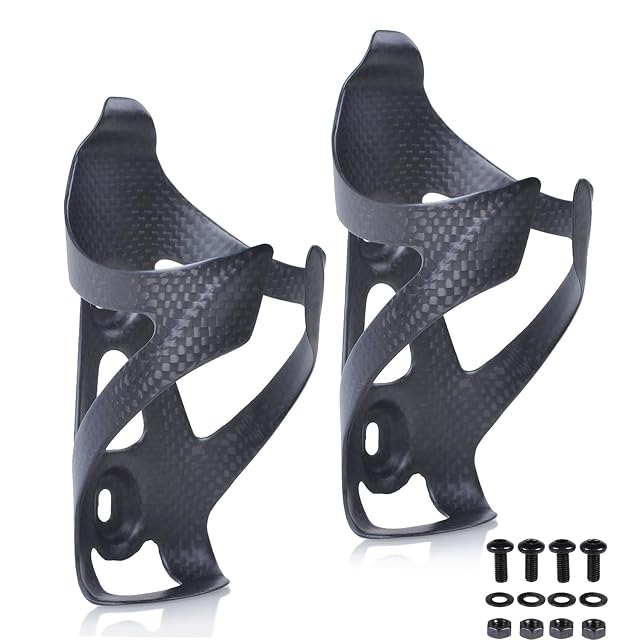
ThinkTop 3K T800 carbon cages, pair, ~25 g (0.9 oz) each
A pair of 3K T800 carbon fiber bottle cages at about 25 grams each, for bottles 71 to 75 millimeters in diameter.
What you are getting
Two cages in genuine 3K T800 carbon fiber, about 25 g each (68 g the pair as shipped), taking bottles of 71 to 75 mm diameter, with black stainless screws. $27.98 — $13.99 a cage, the most expensive here.
Twenty-five grams, which is half an alloy cage
ThinkTop ~25 g (0.9 oz), ROCKBROS polycarbonate 30 or 35 g (1.2 oz), PRO BIKE TOOL machined alloy 48 g (1.7 oz).
So carbon saves about 23 g (0.8 oz) a cage against machined alloy — 46 g (1.6 oz) on a bike with two. That is a real saving in the terms a weight-conscious rider uses, and a trivial one in any other terms: a full 750 ml bottle weighs 750 g (26.5 oz).
The introduction to this shelf states the cost of that saving: “a light carbon or composite cage can hold less firmly on rough ground than a slightly heavier alloy one”. ThinkTop’s second bullet is an answer to precisely that.
And the second bullet is an unusually honest admission
“According to the customer’s suggestion, and after many tests, we focused on strengthening the middle arms on both sides and bottom of the bottle cage easy to break, and added three layers of high-intensity carbon fiber cloth on the original basis.”
Read that again: the arms and the bottom were easy to break, and three layers of cloth were added. That is a manufacturer describing a failure mode in its own earlier product and the fix.
It is worth more than any claim on this page. A carbon cage fails at the arm root, under vibration, and knowing the maker went back to it is better information than “incredible strong”.
The tightest bottle window on this page
71 to 75 mm, on a cage 72 mm across, and the listing says what happens outside it: “bottle too big or too small may not fit firmly”.
That is a 4 mm (0.16 in) window. The FiveBox cage on this page takes 68.9 to 76.2 mm (2.71 to 3 in) — a 7.4 mm (0.29 in) window — and the PRO BIKE TOOL flexes ±5 mm (0.20 in).
Carbon has that consequence: a cured laminate has far less give than a sprung alloy arm, so the fit is narrower by construction. Measure the bottle before ordering, and do not expect an insulated bottle to go in.
3K T800, which is a real fiber designation
“Genuine 3K T800 carbon fiber.”
3K is the weave — three thousand filaments per tow, the standard visible twill. T800 is a fiber grade, stiffer and stronger than the common T300. Whether a cage made of it is actually laid up to those properties is another question, but the designation is specific rather than decorative, and no other cage on this page names its material to that level.
The third bullet is entirely about looks
“We designed hundreds of samples with different gloss, and finally selected the most suitable sample… to better reflect the beautiful pattern of 3K carbon fiber than most products, more luxurious.”
On a visible component that is a legitimate concern, and it is a whole bullet out of five.
Top entry, and the hardest of the five to use on a small frame
Carbon with a 4 mm (0.16 in) window and no flex is the least forgiving combination here. The buying advice on this shelf — measure the gap between boss and top tube — matters most on this cage, because there is no give to work with.
What is not published
No bolt spacing, no cage dimensions beyond the 7.2 cm diameter, no layup count for the main structure (three layers were added, to an unstated base), and no statement about torque — which on a carbon part is the figure that prevents cracking. Overtightening a bolt into a carbon cage is the commonest way one dies, and nothing here warns about it.
Availability
Read on the day this page was built: $28 at the American Amazon shop.
Read from Keepa on the day this page was last revised; stock and price both move without notice.
Prices quoted in this text were read on 2026-10-06. The live price is at the top of the page.