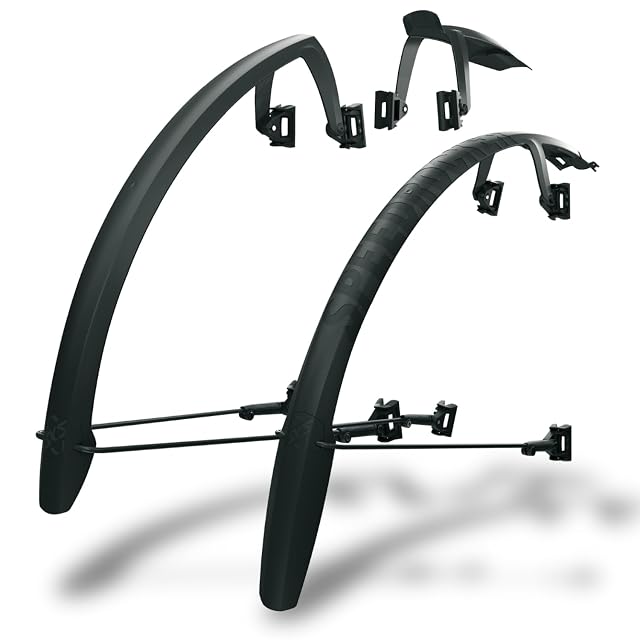
One: mudguards
Full-length if your frame has eyelets, clip-on if it does not. Clip-ons cover about half as much and fit anything.
The measurement that decides fit is tire clearance, not wheel size — the gap under the fork crown and at the seatstay bridge.
Full-length guards also keep the spray off whoever is riding behind you.
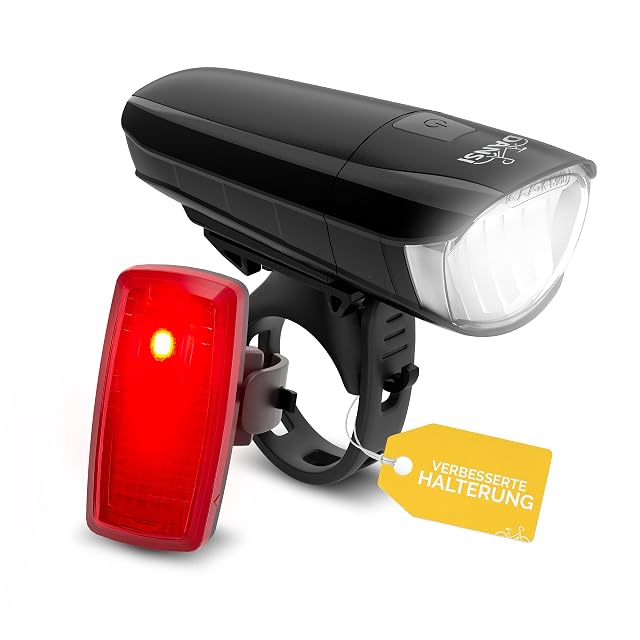
Two: lights that see, not only lights that are seen
On a lit street a light exists to be seen. On an unlit lane it has to show you the surface, and those are different amounts of output.
Lux describes the light landing on the road; lumens describe the source. An approved beam has a defined upper cut-off, so a brighter approved lamp puts more light on the road rather than into oncoming faces.
Three: tires with a named protection layer
Winter punctures come from grit washed into the road, not from the cold. A protection belt is the difference between an occasional puncture and a weekly one — and a published thickness, like Fincci’s 1 mm (0.04 in), is one of the few comparable figures in the category.
Go a little wider and a little softer, inside the range printed on your sidewall.
Four: a wet lube
Wet lube survives water where dry lube washes off. Re-lube after every wet ride; that matters more than which bottle.
Five: warm extremities
Windproof covers over gloves and shoes do more than thicker insulation, and a warm core is what lets your body send blood to your fingers at all.
And the habit that saves the bike
Rinse after salted rides, before the salt dries.
The questions riders ask
What is the highest-value winter purchase?
Mudguards. Most of the water on a rider comes off their own wheels, and a wet stripe up the back is the reason people stop riding in November rather than the temperature.
Do I need studded tires?
Only if you actually ride on ice. They are slow, heavy and noisy on clear tarmac, and most winters in most places do not need them. A wider tire with a named protection layer, run a little softer, is the usual answer.
Last reviewed 30 August 2026