A published weight, and the only cage here that takes an insulated bottle
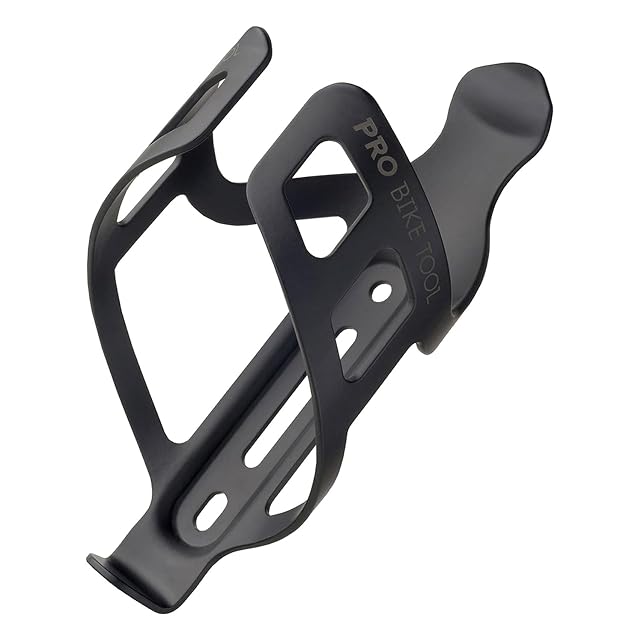
PRO BIKE TOOL Machined alloy cage, 48 g (1.7 oz), 500–950 ml
A CNC-machined aluminum bottle cage at 48 g (1.7 oz), flexing about five millimeters to hold bottles from 500 to 950 ml.
What you are getting
A single CNC-machined aluminum cage, heat-treated, powder-coated, weighing a published 48 g (1.7 oz), holding bottles of 500 to 950 ml (20 to 33 oz), with oval mounting holes and two stainless bolts. $8.99 — the cheapest single cage on this page.
It publishes a weight, which this shelf had never seen
48 g. Until this group, the introduction to this page ended with the sentence “no cage here publishes a weight” — true of all three cages published before it.
Forty-eight grams places it: the ThinkTop carbon cages on this page are about 25 g (0.9 oz) each and the ROCKBROS polycarbonate is 30 or 35 g (1.2 oz). So machined alloy is roughly twice the weight of carbon, which is the trade the introduction to this shelf describes from the other side — “a light carbon or composite cage can hold less firmly on rough ground than a slightly heavier alloy one”.
The widest bottle range on this page
500 ml to 950 ml, which is 20 to 33 oz. The CNC cage here takes 600 to 800 ml; the ROCKBROS states 20 to 21 oz.
And it says how: “one-piece flexible design adjusts ±0.2 inch” — about ±5 mm (0.20 in) — “to hold insulated or regular bottles”.
Insulated is the one worth noting. A vacuum bottle is noticeably fatter than a standard cycling bottle at the same volume, and most cages will not take one. This is the only cage in this survey to name them.
“Comes with 2 stainless steel bolts and oval mounting holes for frame adjustment.”
Slots rather than round holes, so the cage can slide a few millimeters up or down the frame. That does two things: it accommodates bosses that are not exactly 64 mm (2.52 in) apart, and it lets the cage be positioned lower on the down tube — which on a small frame is sometimes the difference between a bottle coming out and not.
The FiveBox cage on this page publishes the range instead: 56 to 71 mm (2.20 to 2.80 in). Both are solving the same problem; one gives a number.
Machined, heat-treated and powder-coated — three processes named
“CNC machined aluminum alloy with heat-treated strength… polished, powder-coated finish for easy cleaning.”
Machining from solid rather than bending from sheet, heat treatment for the spring in the arms, and powder coating over polish. None of those is quantified, but all three are real manufacturing steps and no other alloy cage on this page names any.
What is missing is the alloy grade — the CNC cage on this page names 6061, and this does not.
It is sold singly
One cage, $8.99. The CNC pair is $15.99 ($8.00 each), the FiveBox pair $9.99 ($5.00 each), the ThinkTop carbon pair $27.98 ($13.99 each).
So this is the most expensive alloy cage per unit except the carbon — and it is the one that publishes a weight, a bottle range, an adjustment figure and three processes.
Top entry, and no side-entry option in this group
As with all five cages in this American survey. The buying advice on this shelf — measure the gap between boss and top tube — applies, and the oval holes give you a few millimeters of help with it.
What is not published
No alloy grade, no cage dimensions, no bolt spacing figure, no arm width, and nothing about whether the arms can be bent to adjust retention. “±0.2 inch” is the flex figure, which is better than nothing and is not the same as a fitment range.
Availability
Read on the day this page was built: $9 at the American Amazon shop.
Read from Keepa on the day this page was last revised; stock and price both move without notice.
Prices quoted in this text were read on 2026-10-06. The live price is at the top of the page.