First: measure the old one
A chain wear gauge drops into the chain and shows whether it has stretched past a threshold. The common thresholds are 0.5 % for 11- and 12-speed chains and 0.75 % for 10-speed and below; two-sided checkers carry both marks. A chain that passes its limit has already started to wear the sprockets it runs on.
No gauge? A chain has half-inch pitch, so 24 links measure 12 inches when new. At 12 1/16 in, it has stretched about 0.5 %.
If the chain is well past its limit, expect to replace the cassette too: a new chain on sprockets worn to match an old one skips under load.
Choosing the replacement
Speed count is the only number that has to match: count the rear sprockets. Single-speed and hub-gear bikes take a 1/8 in wide chain; derailleur drivetrains take 3/32 in or narrower, and chains get narrower as the speed count rises.
Chains from different makers at the same speed count are often interchangeable, and several makers say so. Mixing speed counts is not the same thing and does not work.
Setting the length
New chains ship long. Use the length-setting method your derailleur maker publishes, not a rule of thumb. Shimano’s common method runs the chain around the largest chainring and largest sprocket without threading the derailleur, then adds two links (one inch); SRAM’s 12-speed Eagle groups use a sizing chart based on chainstay length and a chain-gap tool. Too short, and the derailleur is over-extended on the largest sprocket, which can tear off the derailleur and the frame hanger in one shift; too long, and the chain slaps and shifts vaguely.
Joining it
Most modern chains join with a quick link rather than a pressed pin, and several makers state that a pressed joint is not permitted on their chains. Shimano and KMC state that their 11- and 12-speed quick links are single-use; some wider links, such as SRAM’s PowerLink for 6 to 8 speeds, are sold as reusable. It is printed on the packaging.
Afterwards
Turn the cranks backwards slowly and watch the chain pass through the derailleur pulleys, looking for a stiff link. Then shift through every gear on a stand before riding.
The chain tool question
Tool makers publish the speed range each chain tool covers, and several state that a tool is not for 11- or 12-speed use. A tool built for wider chains supports narrow plates unevenly and bends them.
The parts on this site
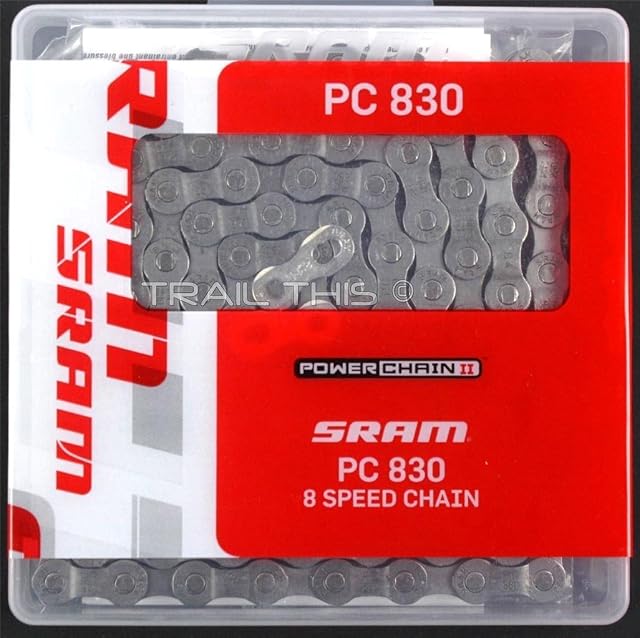
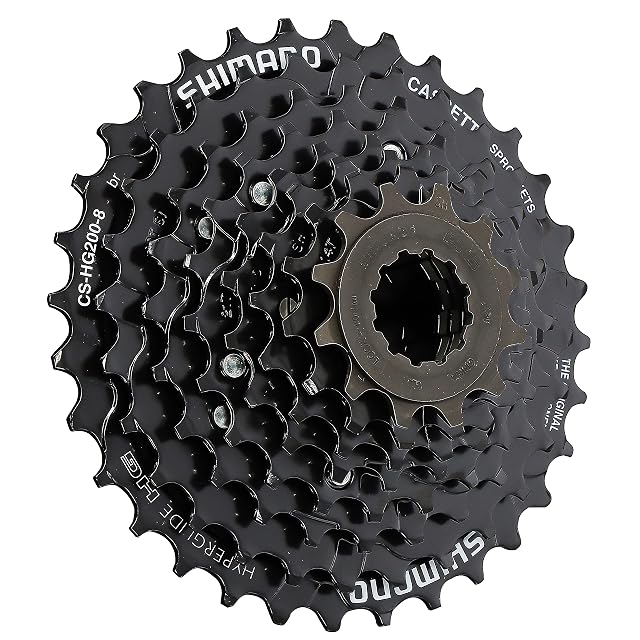
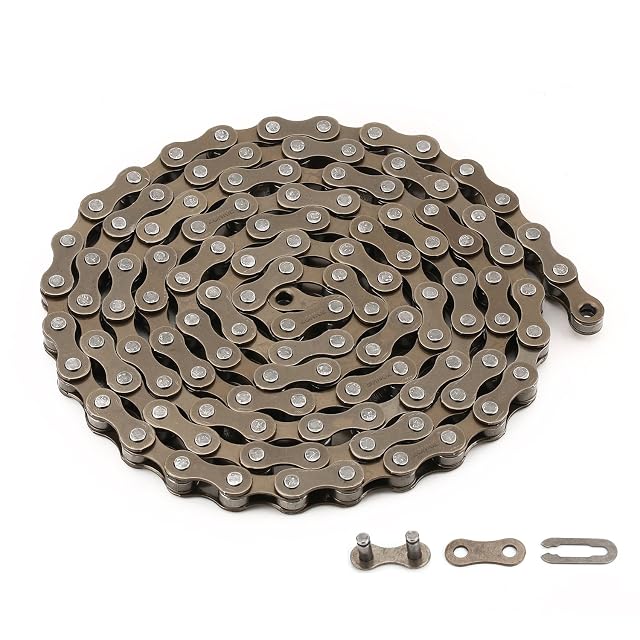
For an 8-speed bike, the SRAM 6/7/8-speed chain (114 links, PowerLink included) was $14.99 on Amazon.com on October 25, 2026, and the matching Shimano CS-HG200 8-speed cassette (12–32T) $23.44. A single-speed or BMX bike takes a 1/8 in chain such as the Zonkie at $13.88.
Prices quoted in this text are dated readings and can differ from the live price in the buy box.
The questions riders ask
How do I know which chain to buy?
Count the sprockets on the rear wheel. That number is the chain’s speed rating, and it is the one specification where a near miss does not work at all. Single-speed and hub-gear bikes take a wider 1/8 in chain; derailleur bikes take 3/32 in or narrower, getting narrower as the speed count rises.
When is a chain worn out?
When it has stretched past the limit of its gauge: 0.5 % for 11- and 12-speed chains, 0.75 % for 10-speed and below, the two marks on a common two-sided checker such as Park Tool’s CC-3.2. Without a gauge, a ruler works: 24 half-inch links measure exactly 12 in when new; at 12 1/16 in the chain has stretched about 0.5 %.
How long should the new chain be?
Use the method your derailleur maker publishes. Shimano’s common method wraps the chain around the largest chainring and largest sprocket, bypassing the derailleur, and adds two links; SRAM’s 12-speed Eagle groups use a sizing chart and a chain-gap tool instead. Following the wrong method can leave you a full link out.
Can I reuse a quick link?
Check the packaging. Shimano and KMC state that their 11- and 12-speed quick links are for single use; some wider links, such as SRAM’s 6-to-8-speed PowerLink, are sold as reusable.
Last reviewed October 25, 2026