Skip to content

Fitting a tire that is too tight

A tire that will not go on is almost never too small — it is usually the bead sitting on the shoulder of the rim rather than in the well.

The technique, which solves most cases

Get one side of the tire on. Then, with the second side, start opposite the valve and work both ways round toward it.

As you go, push everything you have already fitted into the center channel of the rim. That is where the slack is. Do this repeatedly — every few centimeters, not once at the start.

Leave the valve for last, and push the valve up into the tire before the final section goes on. A tube bunched around the valve is what takes the last of your slack.

Warmth helps

A tire that has been in a cold garage is stiffer than one that has been indoors. Ten minutes in a warm room genuinely changes it.

Levers, if you must

Two plastic levers, and use them to lift the bead over rather than to pry along. Levers that clip onto a spoke free a hand and turn a two-hand job into a one-hand one.

Go slowly near the end. Almost every pinched tube happens in the last twenty centimeters.

Tubeless is harder

A tubeless bead is designed to grip, which is the point. Some manufacturers engineer specifically around this step — Panaracer names BeadLock on its GravelKing.

Soapy water on the bead helps it slide, and it evaporates.

Before you inflate

Push the tire sideways all the way round on both sides and check no tube is visible. Then inflate to low pressure, check the bead line sits evenly all the way round, and only then go to riding pressure.

When it genuinely will not go

Check the ETRTO numbers on the tire against the rim’s. The bead seat diameter must match exactly.

The questions riders ask

Why does pushing the tire into the middle of the rim help?

The rim is deeper in the center than at the edges. A bead sitting in that well has slack, and that slack is what lets the last section go over. A bead sitting on the shoulder has none, which is why the last twenty centimeters feels impossible.

Can I use a screwdriver instead of a lever?

No. A metal edge damages the rim and cuts the tube or the tire bead, and the damage is often not visible until it fails. Plastic levers cost very little.

Last reviewed August 30, 2026
What this assumes you ride

Everything above works with what you already own. These are the products we would reach for, and each links to the full review rather than straight to a shop.

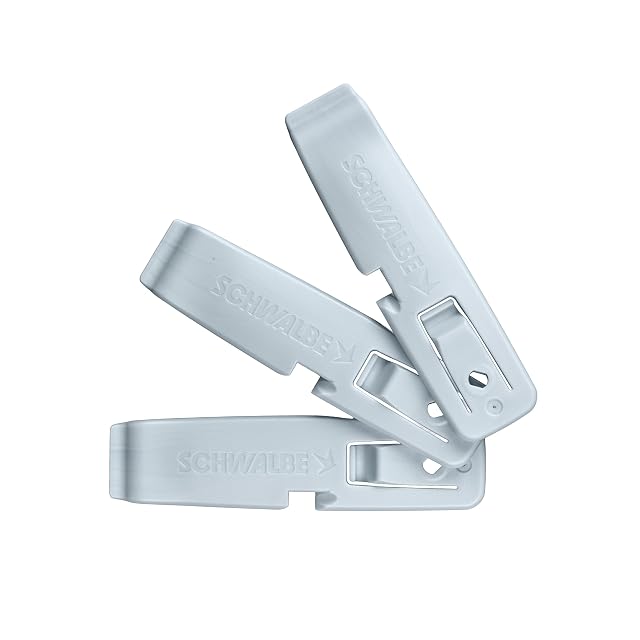
  • Schwalbe three-piece tire lever set in blue

    Schwalbe Tire levers, 3-piece with valve key

    Three Schwalbe tire levers with a spoke-clip function and an integrated Presta valve core key.

    Quantity
    3 levers
    Function
    Clips into a spoke to hold the bead
    Integrated
    Presta (SV) valve core key
    Suits
    Road, MTB and e-bike tires
    EAN
    4026495951005
    • The spoke clip holds the bead so you can move the next lever along, which is what makes a tight tire possible single-handed
    • An integrated valve core key, which you otherwise need for tubeless top-ups
    • Plastic levers can snap on a very tight tubeless bead

    Best for: Every bike. This is the tool that makes a roadside repair possible at all.

    ≈ $8.54
    Check price on Amazon
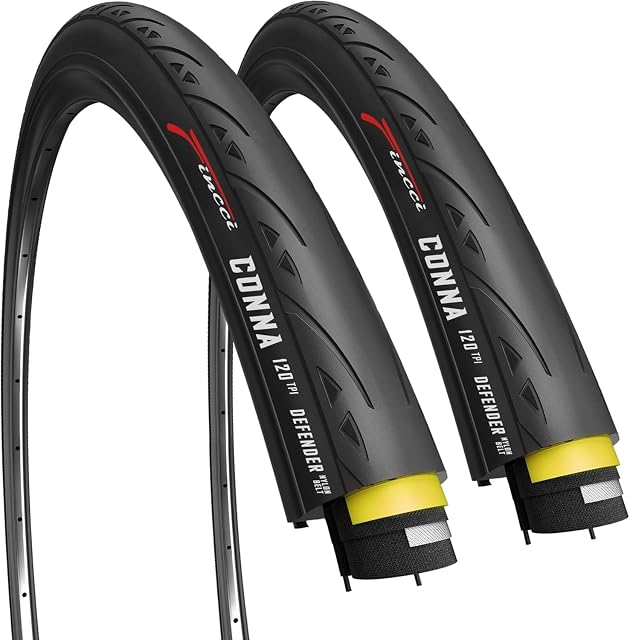
  • Pair of Fincci folding road tires in black

    Fincci Conna 700x25C folding, pair

    A pair of folding 700x25C tires at 7.1 oz (200 g) each, with a 120 TPI casing, a stated 1 mm (0.04 in) puncture protection layer and a Kevlar bead.

    ETRTO size
    25-622 (700x25C)
    Quantity
    2 tires
    Weight
    7.1 oz (200 g) each
    Casing
    120 TPI
    Protection
    1 mm (0.04 in) layer
    Bead
    Kevlar
    EAN
    5060567312492
    • The most completely specified tire here — weight, TPI, protection thickness and bead all published
    • A pair rather than a single tire
    • A 120 TPI casing is less supple than the Continental's 180

    Best for: Replacing both road tires at once, with the protection layer figure actually published.

    ≈ $46.79
    Check price on Amazon

Prices quoted in these summaries are dated readings. The live price is shown next to each product.