Before you turn anything: two checks
The hanger. Stand behind the bike at wheel height. The derailleur cage should hang parallel to the sprockets. A cage leaning inward at the bottom is a bent hanger, and no adjustment fixes it.
The cable. If shifting is crisp in one direction and reluctant in the other, that is friction in the housing, not tension. Cable tension moves the derailleur one way and a spring returns it the other, so friction shows on the spring’s side first — and the fix is new inner and outer, not the adjuster.
The adjustment
Bike in a stand, or upside down. Shift into the middle of the cassette.
Pedal, shift up one sprocket, then down one. Hesitating on the way to a larger sprocket means not enough tension: quarter turn counterclockwise. Overshooting or rattling means too much: quarter turn clockwise.
Work through the whole cassette. The middle is where you set it; the extremes are the limit screws’ job.
When the adjuster runs out
If you have wound it nearly all the way out, the cable has stretched past the adjuster’s range. Wind it most of the way back in, undo the cable clamp bolt, pull the cable taut with pliers, re-clamp, and start again.
The limit screws
Marked H and L. They set how far the derailleur can travel at each end, and they are not part of indexing — set them only if the chain will not reach the largest or smallest sprocket, or if it is going past one.
Quarter turns, and check by hand before pedaling.
The front derailleur
Same principle, and the cage position matters as well: its outer plate should clear the largest chainring by about 1 to 3 mm and run parallel to it, the range Shimano gives for its front derailleurs.
What a stand changes
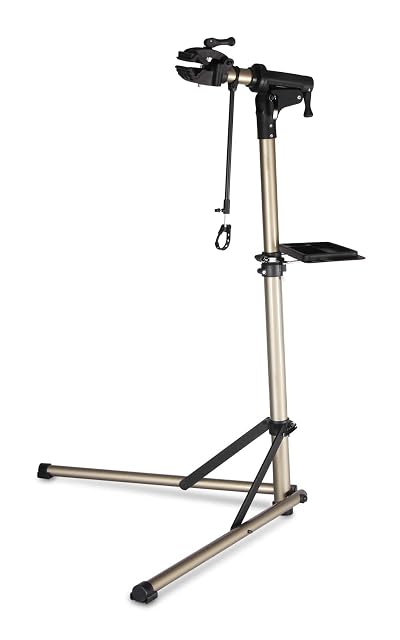
All of this is easier with the bike at chest height and the bars held still.
The questions riders ask
Which way do I turn the barrel adjuster?
Counterclockwise, winding it out of the derailleur, adds cable tension and moves the chain toward the larger sprockets. That one sentence covers most gear adjustment.
How much should I turn it?
A quarter turn at a time, testing after each. Half a turn is usually too much, and the temptation to make a big correction is what turns a five-minute job into an hour.
Last reviewed October 29, 2026