A dual head fits Presta and Schrader without an adapter to lose · review
DUNLOP Track pump with 12 bar gauge and adapter box review
A foot-braced track pump reading to 12 bar with a three-valve hose end, and a transparent box on the barrel holding the ball needle and inflatable adapter.
Our conclusion The pump for a shed with mixed valves. Every valve type at the hose end and the ball needle kept on the pump, at the cost of a plastic body where two rivals here state steel.
Dunlop’s track pump answers one question completely: what fits every valve in the house.
What the manufacturer publishes
A foot model with a robust handle and a stable base, designed to be held down by both feet during use. Two openings at the end of the hose covering three valve types — Presta, Dunlop and Schrader. A gauge in the base reading to 180 psi or 12 bar. A transparent storage box mounted on the pump holding two further adapters, one a needle valve for balls and one for inflatable toys. A plastic body.
Why the valve coverage is the point
Dunlop valves are still standard on a great many European city bikes, and they are the ones that catch people out: neither a Presta nor a Schrader fitting is the right replacement for one. A hose end that takes all three means no adapter to screw on, and no adapter to lose.
The extra two adapters matter for the same reason. Every pump ships with a ball needle; almost every ball needle is in a kitchen drawer by the following summer. Mounting the box on the pump is a small decision that changes whether the thing is still there in a year.
Where it is ordinary
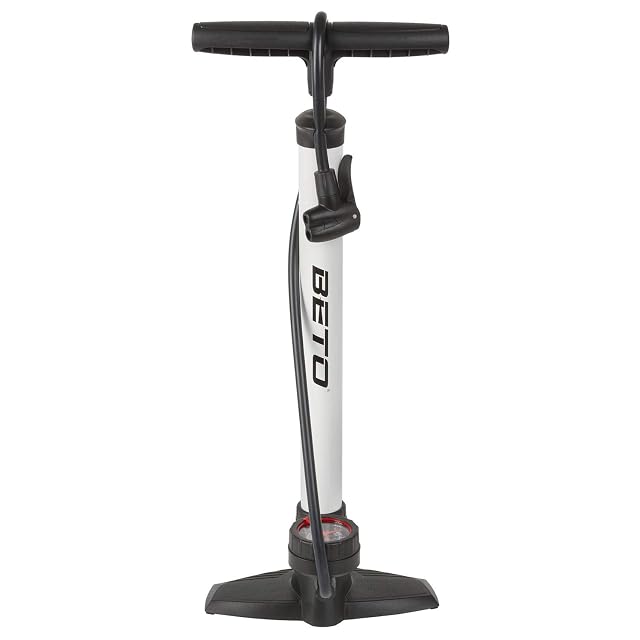
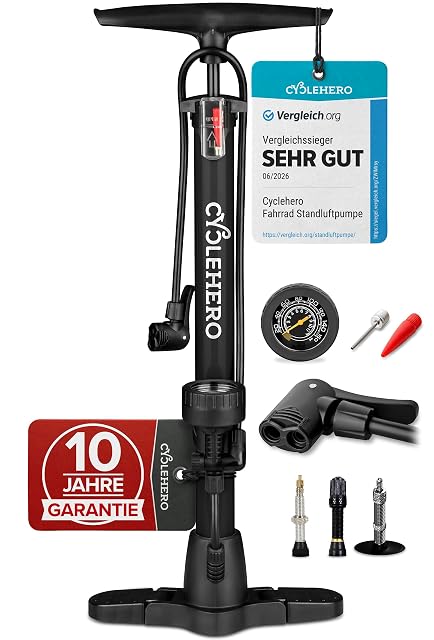
The body is plastic, and both the Beto and the CYCLEHERO in this hub state steel. That is the honest trade at this price, and it shows up over years rather than months.
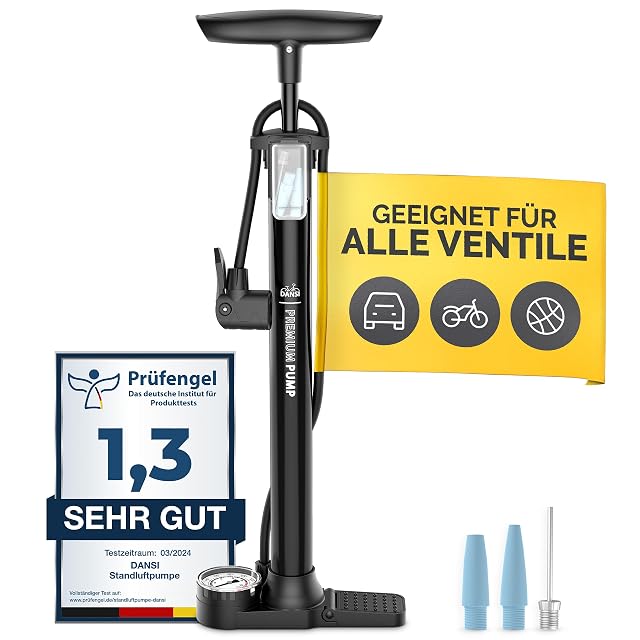
Dunlop also publishes no barrel height, which is the figure that decides whether you pump with body weight over the handle or with your back. The DANSI and CYCLEHERO pumps here both state 60 cm (23.6 in); this one does not say.
The gauge position
The gauge is in the base rather than at hand height. It is perfectly readable, and it means looking down at the floor rather than straight ahead — which is worth knowing if you check pressures often and your knees would rather you did not.
Availability
Catalogued and unsold: the American Amazon shop lists the reference with nobody behind it.
Read from Keepa on the day this page was last revised; stock and price both move without notice.
What we rate and what we flag
Strengths
12 bar and 180 psi, the highest stated ceiling in this hub
All three valve types at the hose end, with no adapter to fit or lose
The two extra adapters live in a box mounted on the pump, not in a drawer
Compromises
A plastic body where the Beto and CYCLEHERO pumps in this hub state steel
The manufacturer publishes no barrel height, which is what decides how hard the pump is to work
The gauge sits in the base, so you read it looking down rather than at hand height
Where this model is listed
A listing is not an offer: the reference exists on these stores, availability changes daily.
France
Germany
Italy
Spain
United Kingdom
United States
Specifications
Maximum pressure
12 bar / 180 psi
Valve types
Two hose openings covering Presta, Dunlop and Schrader
Gauge
Mounted in the base
Adapters
Ball needle and inflatable-toy adapter, in a box on the pump
Body
Plastic
Amazon reference
B08FXMMY2N (identical on 6 markets)
EAN
8711252170497
The questions riders ask
Which valves does it fit?
Dunlop states two openings at the end of the hose covering three valve types: Presta (French), Dunlop (Dutch) and Schrader (car). That is every valve you will meet on a bicycle, without an adapter to fit.
What are the extra adapters for?
A needle valve for balls and an adapter for inflatable toys, supplied in a transparent box mounted on the pump. Keeping them on the pump rather than in a drawer is the difference between having them and having had them.
Is 12 bar useful on a bicycle?
Not directly — no bicycle tire runs at 12 bar, and most road tires sit between 6 and 8. What a high ceiling means in practice is that road pressures are reached in the comfortable middle of the gauge rather than at its far end.
Our score
8.1/ 10
The pump for a shed with mixed valves. Every valve type at the hose end and the ball needle kept on the pump, at the cost of a plastic body where two rivals here state steel.
Who buys this one, among bike gear
A household with several bikes and a football, where one pump has to cover every valve in the shed.
What buyers actually choose
Amazon reports what buyers took in the month before this page was last checked: at least 600.
The figure is a floor, rounded by Amazon, and read through Keepa — it says what buyers picked, not what a maker claims.
Sources
Specifications: the manufacturer sheet for bike gear and the matching Amazon product page. Prices and availability: Keepa. Every figure on this page names its source.
60 cm (23.6 in) steel · 11 bar · 25 cm (9.8 in) base · 10-year warranty
A 60 cm (23.6 in) steel track pump with a 25 cm (9.8 in) base, a 22 cm (8.7 in) handle and a 65 cm (25.6 in) hose, rated to 11 bar and carrying a ten-year manufacturer warranty.
Best for: A pump bought once, for a household that will still be inflating tires in ten years.
60 cm (23.6 in) barrel · dual head SV/AV/DV · gauge with marker
The best-selling track pump here: a 60 cm (23.6 in) barrel on a wide base, a dual head sealing on all three valve types, and a gauge with a manually adjustable target marker.
Best for: The default household track pump, for a family of bikes at mixed pressures.