What you are getting
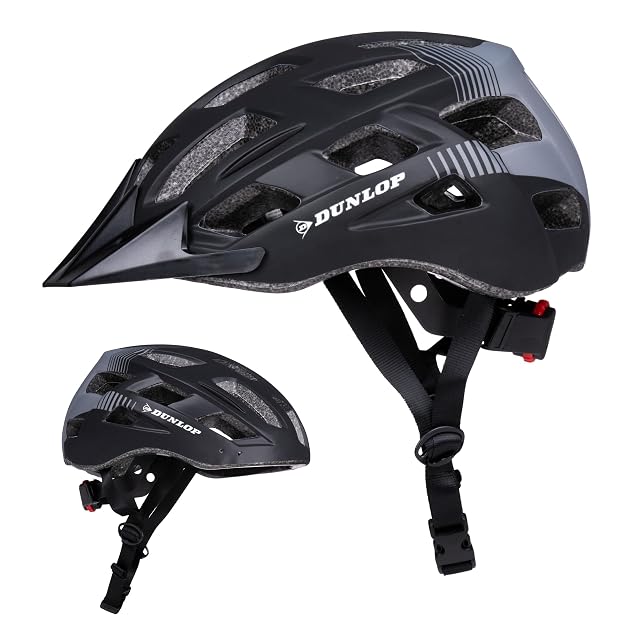
A size M recreational helmet with the MIPS system, two liners of different thickness — 0.23 and 0.31 inch, so 5.8 and 7.9 mm (0.31 in) — an adjustment dial, a removable visor, and 25 individual vents. $59.99.
Two liner thicknesses, which is a fit idea nothing else here has
“2 different thicknesses liners (0.23 & 0.31 inch) and the adjustment dial maximize the head fit, flexibly adapted to different kinds of cycling glasses and avoid pulling hair.”
A dial tightens a cradle round the back of the head. It does not change the gap between the shell and the top of the skull — and that gap is what decides whether a helmet rocks, whether glasses arms foul the edge, and whether the pads bear evenly.
Two liners, 2.1 mm (0.08 in) apart, change it. That is the only adjustment of its kind in this group, and the introduction to this shelf points at the general problem: the ranges behind a letter differ between makers, so a size M is a guess until the helmet is on.
The glasses point is specific and real: a thinner liner drops the shell, and a dropped shell meets the top of a pair of cycling glasses.
MIPS at $59.99, against $119.95
The Giro Agilis on this page is the only other MIPS helmet here, at twice the money, and its MIPS is Integrated — built into the fit system rather than added as a separate layer.
This listing describes MIPS plainly and with appropriate hedging: “designed to provide added safety for helmets in many accidents. For certain impacts, the system can reduce harmful rotational forces.”
Many, and certain. That is more careful wording than most safety copy, and it is the honest shape of the claim: MIPS addresses angled impacts, not all impacts. Nothing on this page assesses how any helmet behaves in a crash.
Twenty-five vents, and multi-sport use
“Equipped with 25 individual vents… when skating, cycling, BMX, MTB and more.”
Vent counts in this group: BATFOX 18, Schwinn 20 or 21, OutdoorMaster 25, Favoto 26, Giro not stated.
The multi-sport claim is worth a caution of its own: skating helmets and cycling helmets are certified to different standards — the BATFOX and Favoto helmets on this page name ASTM F1447, which is the bicycle standard — and this listing names no standard at all. A helmet sold for skating ought to say which skating standard it meets.
And it names no standard
Five bullets, and not one names CPSC, ASTM or CE. Any helmet sold in the United States must comply with the CPSC bicycle helmet standard; this listing simply does not say so, and a declared marking is the only thing a comparison page can report.
The Schwinn on this page names CPSC and its extended-head-coverage provision; the Favoto and BATFOX name three markings each.
399 g (14.1 oz) is the box, not the helmet
The shipping record says 399 g (14.1 oz). The only helmet on this page to publish its own weight is the Favoto, at 260 g (9.2 oz).
A MIPS recreational helmet in M is typically nearer 300 g (10.6 oz) than 400, and the difference is the carton and the second liner. Treat 399 g (14.1 oz) as the parcel.
What you get in the box, listed
“1 × helmet, 2 × liners, OutdoorMaster’s friendly customer service.” The second liner is the one thing on this list that is a part rather than a courtesy, and it is the reason to choose this helmet.
What is not published
No head circumference for M — on a shelf whose buying advice is to measure and compare to the range — no weight of its own, no safety standard, no MIPS version, and no statement of which liner is fitted when it arrives.
Availability
Read on the day this page was built: $60 at the American Amazon shop.
Read from Keepa on the day this page was last revised; stock and price both move without notice.
Prices quoted in this text were read on 2026-10-06. The live price is at the top of the page.