What you are getting
A Medium Giro Agilis: a two-piece shell — a hard outer shell with a polycarbonate Hardbody lower wrap fused permanently to the EPS liner by Giro’s In-Mold process — Integrated MIPS, the Roc Loc 5 fit system, and Wind Tunnel ventilation. $119.95, nearly five times the cheapest helmet on this page.
Roc Loc 5 adjusts two things, which is unusual
“Allows you to easily custom-tune the fit tension and fore-aft tilt of a helmet in seconds, using a single hand.”
Two axes. Every other helmet in this group has a dial that tightens a cradle; this one also changes the angle at which the cradle sits, which moves the helmet’s front edge up or down on the forehead.
The introduction to this shelf names that distinction: dial systems allow finer changes than a sliding band, “and only some adjust in height as well”. This is one of them.
Why it matters is fit rather than comfort. A helmet sitting too far back leaves the forehead uncovered, and a cradle that cannot be tilted cannot correct it.
The shell is described as two parts, and that is the construction
“The two-piece shell combines a tough outer hard shell with a polycarbonate lower shell permanently fused to the liner.”
Most helmets at this price are pure in-mold: a thin polycarbonate skin bonded to foam in the mold. The Agilis adds a harder outer over the top and extends the polycarbonate round the bottom edge — which is where a helmet gets chipped on bike racks, car boots and floors.
The description adds the mechanism: the Hardbody shell “extends to the inside of the helmet… fused permanently to the EPS foam liner using our In-Mold process to enhance durability and ventilation without excess bulk”.
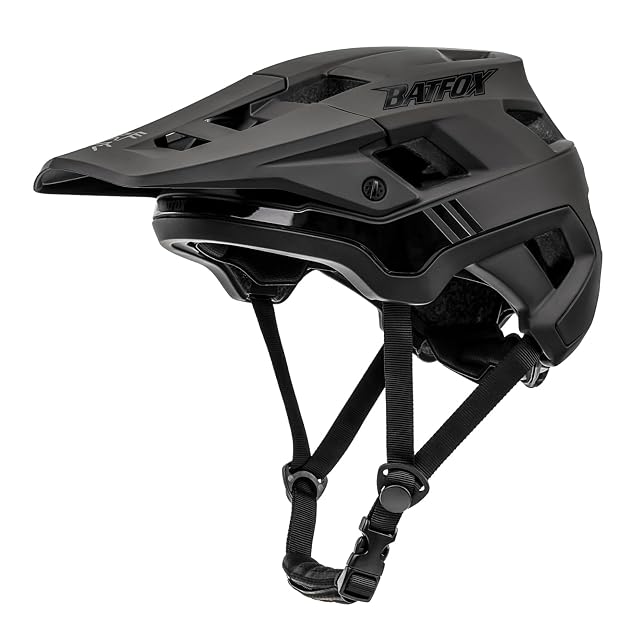
The BATFOX and Favoto helmets on this page describe the same in-mold idea in one sentence each; this is the only listing that separates the layers.
Integrated MIPS, and what the listing claims for it
“The goal of Giro’s Integrated Mips-equipped helmets is to reduce rotational forces while enhancing fit and comfort by combining the Mips slip plane with the helmet’s adjustable fit system.”
MIPS is a low-friction layer that lets the shell move a few millimeters relative to the head in an angled impact. Integrated MIPS builds that movement into the fit system rather than adding a separate plastic liner, which is why this helmet has no extra yellow shell inside.
The OutdoorMaster helmet on this page also has MIPS, as a separate system, for $59.99 — half the price.
What neither listing does is quantify anything, and nothing on this page assesses how a helmet behaves in a crash.
And it names no standard
“All Giro helmets are designed to reduce as much energy as possible while meeting and exceeding stringent safety standards.”
Which standards is not said. The Schwinn helmet on this page names CPSC with its extended-head-coverage provision; the Favoto names CPSC, ASTM and CE; the BATFOX names CPSC, ASTM F1447 and CE.
Giro certainly certifies its helmets — a helmet cannot be sold in the United States without CPSC compliance — but this listing does not say so, and a declared marking is the only thing a comparison page can report.
The record for this listing says 671 g (23.7 oz). A medium road helmet weighs nothing like that; the Favoto on this page publishes 260 g (9.2 oz) for itself and the heaviest shipping weight otherwise here is 399 g (14.1 oz).
So 671 g (23.7 oz) is the helmet plus its packaging, and Giro publishes no weight of its own. On a $119.95 helmet whose fit system is advertised as “lighter than comparable systems”, that is a conspicuous omission.
Wind Tunnel ventilation, with no vent count
“Active vents in the shell with exhaust channels inside… the most effective cooling system available.”
Internal channelling is a real design: vents alone move air across a shell, channels move it across the scalp. What is missing is the count — Schwinn says 20 or 21, Favoto 26, OutdoorMaster 25, BATFOX 18 — so this is the one helmet here whose ventilation cannot be compared numerically.
What is not published
No head circumference range — “Medium” with no centimeters, on a shelf whose buying advice is to measure and compare to the range, not the letter — no weight, no standard named, no vent count. Four bullets, all of them about named technologies.
Availability
Read on the day this page was built: $120 at the American Amazon shop.
Read from Keepa on the day this page was last revised; stock and price both move without notice.
Prices quoted in this text were read on 2026-10-06. The live price is at the top of the page.