What you are getting
An adult mountain bike helmet with a shell in PVC and polycarbonate over an EPS foam liner, a single-hand dial retention system, and a reinforced large sun visor that “is easy to move upward to offer you broad sights”. $29.99.
It names three materials, which two helmets here do not
“Material use the tough and durable PVC & PC, EPS foam which help absorb the impact and protect the head during crash.”
Three named materials in one bullet. PVC and polycarbonate for the shell, EPS for the energy-absorbing liner — which is the standard arrangement, and naming all three is more than the Giro (polycarbonate and EPS) or the Schwinn (“microshell”) manage, and about the same as the Favoto’s “high-density EPS and in-mold”.
What it does not say is whether the shell is in-molded — bonded to the foam in the mold — or a separate skin taped over it. That is the construction difference between the Favoto and BATFOX helmets here and the cheaper Schwinn microshell, and it decides edge durability.
The visor lifts rather than detaches
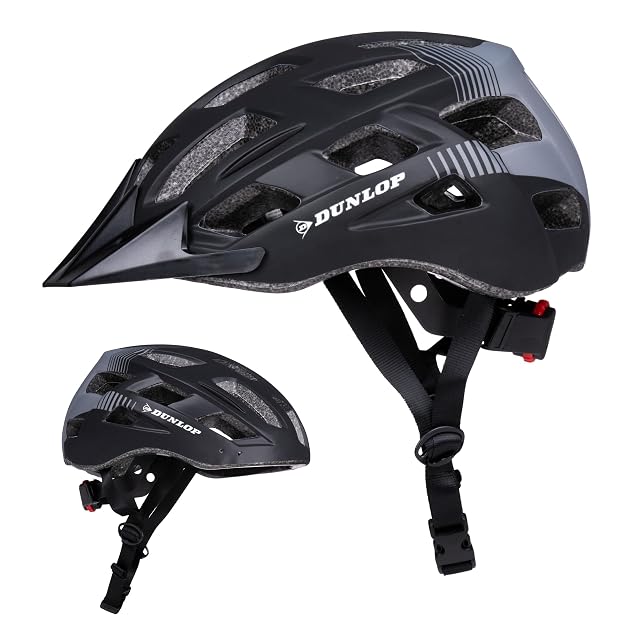
“This reinforced large sun visor is designed perfectly to match this biking helmet — visor is easy to move upward to offer you broad sights.”
A different solution from everything else on this page. The Schwinn, OutdoorMaster and Favoto visors are removable; the BATFOX visor is fixed and large. This one pivots up out of the sightline and stays on the helmet.
For a rider who alternates between a climb in the sun and a fast descent on the drops, a visor that moves without being taken off and lost is genuinely useful — and it is the only one here that does it.
And then it publishes nothing a buyer needs to size it
No head circumference range. None at all, in any bullet.
The introduction to this shelf is built on circumference: sizes are sold as letters and fitted by centimeters, “and the ranges behind those letters differ enough between makers that the same nominal size can be two centimeters apart”. Three helmets on this page publish ranges — Schwinn 58–62, BATFOX 54–63 in three bands, Favoto 58–60 — and this publishes none, not even a letter.
That makes it the one helmet in this group you cannot size before it arrives.
No vent count, on a listing that advertises ventilation
“The adoption of specialized aerodynamic and ventilation design allow air go through the helmet which help increase the speed and keep stay cool.”
Vent counts elsewhere on this page: 18, 20 or 21, 25, 26. Here, none. “Increase the speed” is an aerodynamic claim with no figure behind it, which on a vented mountain helmet is not a claim worth weighing.
And no safety standard
Like the Giro and OutdoorMaster on this page. The Schwinn names the CPSC provision; the Favoto names CPSC, ASTM and CE; the BATFOX names ASTM F1447 by number.
Every helmet sold in the United States must comply with the CPSC bicycle standard. This listing does not say that it does, and a declared marking is the only thing a comparison page can report — nothing here assesses crash behavior, and the buying advice on this shelf stands: a helmet is a replace-after-impact item by its maker’s own instructions.
320 g (11.3 oz) is the parcel
The shipping record says 320 g (11.3 oz) — the second lightest parcel on this page, and not a published helmet weight. The only self-published figure here is the Favoto’s 260 g (9.2 oz).
What is not published
No head circumference, no size at all, no vent count, no weight, no safety standard, no in-mold statement, no MIPS. The fifth bullet is a satisfaction promise.
At $29.99 it is $4.40 more than the Schwinn, which publishes a size band and a standard — and $3 more than the Favoto, which publishes a band, a weight, a vent count and three markings.
Availability
Read on the day this page was built: $30 at the American Amazon shop.
Read from Keepa on the day this page was last revised; stock and price both move without notice.
Prices quoted in this text were read on 2026-10-06. The live price is at the top of the page.