Before anything is loaded: three checks
The receiver size. American hitches take a rack in a square receiver, almost always 1¼ inch or 2 inch. A rack is built for one of the two. Measure the opening, or read it in the hitch’s documentation.
The tongue weight rating, from the label on the hitch and from the owner’s manual. Where they differ, the lower one governs.
The rack’s own weight, which comes out of that rating before any bike does.
What remains is what you can carry, and it is often less than people assume. A 50 lb rack on a hitch rated for 200 lb of tongue weight leaves 150 lb for bikes, which is two e-bikes at most. The rack also has its own limits, per bike and in total: the lowest of all these figures is the one that applies.
Fitting the rack
Follow the rack maker’s instructions exactly. Slide the rack’s shank into the receiver, line up the holes, and fit the hitch pin and its clip. Most racks then tighten an anti-wobble bolt or knob that takes the play out of the receiver; skipping it is what makes a rack sway on the highway.
The receiver is the single point holding everything to the vehicle. This is not a place for improvisation or a borrowed pin of the wrong size.
Loading
Heaviest bike closest to the vehicle. Alternate the bikes front to back so handlebars and saddles do not fight. Secure both wheels and the frame, or the arm and the cradles on a hanging rack.
Remove everything that can come loose: pumps, bottles, computers, bags, and anything mounted on the handlebars.
The frame adapter case
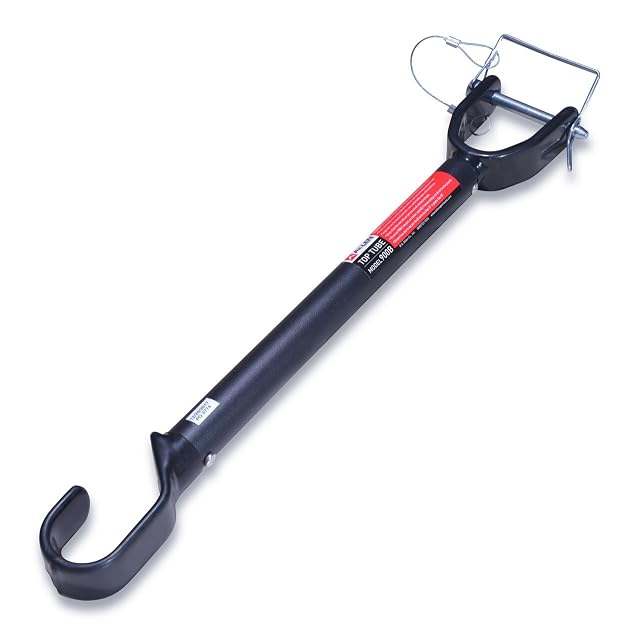
On a hanging rack, the arms clamp a straight top tube. Step-through frames, many kids’ bikes and some full-suspension designs have none. An adapter bar creates one, hooking between the stem and the seatpost: the Allen Sports 900B is made for a handlebar-to-saddle distance of 18.1 to 26.8 in. Platform racks that hold the wheels do not need one.
Plate and lights
A loaded rack can hide the license plate and part of the taillights. Rules on plate visibility and auxiliary lighting are set state by state, so check your state’s motor vehicle agency, and every state on a long route.
On the road
Re-check the hitch pin, the anti-wobble knob and the straps after the first few miles and at every stop. Remember the extra length when backing up and parking, and fold the rack or remove the bikes before opening a tailgate if the rack does not tilt.
Which rack suits which case
For a 1¼ inch receiver, the MaxxHaul 2-Bike includes an adapter for both sizes. For four regular bikes on a 2 inch receiver, the Allen Sports Deluxe 4-Bike tilts for liftgate access. For two heavy e-bikes, compare the TANX with the ramp-equipped Young Electric. The whole shelf lists each rack’s limits.
The questions riders ask
Where do I find my hitch's tongue weight rating?
On the label or plate on the hitch itself, and in the vehicle owner's manual. They can differ, and the lower of the two governs. Subtract the rack's own weight before working out how much bike weight is left.
Can I use a 2 inch rack in a 1¼ inch receiver, or the reverse?
Only with the adapter the rack's maker approves, if it approves one. A sleeve that lets a 1¼ inch rack sit in a 2 inch receiver adds play and leverage, and many makers lower the rack's capacity or rule it out for e-bikes. Buy the rack for the receiver you have.
What if my bike has no straight top tube?
A frame adapter bar creates one. Step-through, many kids' and some full-suspension frames need one with a hanging rack, and it is a separate purchase.
Which rack should I start with?
Start with your receiver and your tongue weight. Our hitch bike racks shelf compares hanging and platform racks for 1¼ and 2 inch receivers, from $58 to $350, with each rack's limits stated.
Last reviewed October 31, 2026