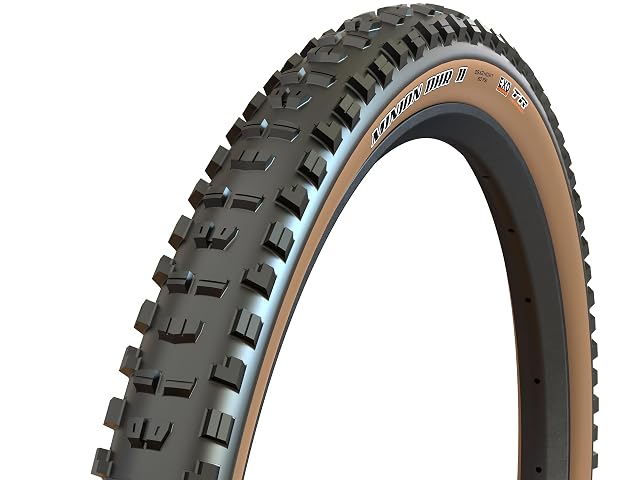
A Maxxis Minion DHR II in 27.5×2.40WT — ETRTO 61-584 — with Dual Compound rubber, EXO sidewall protection, an E25 e-bike rating and a tan sidewall. 2.1 lb (0.9 kg). $57.08.
It is the only genuine trail tire on this page
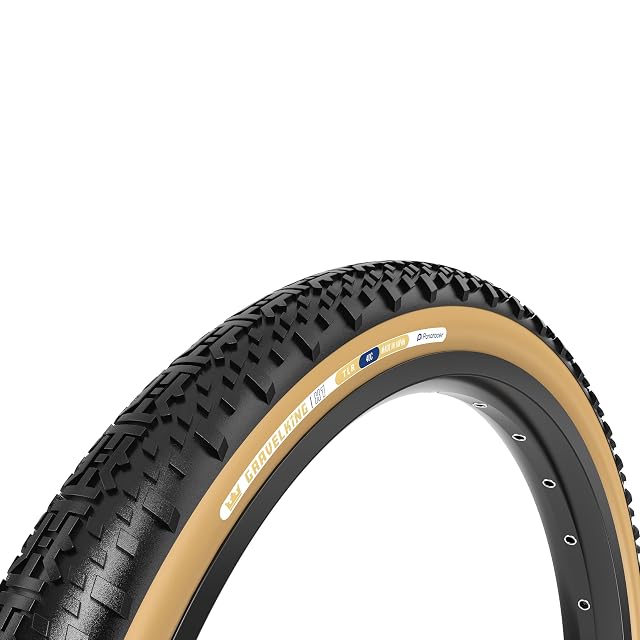
Everything else here is a semi-slick, a slick or a shallow gravel tread. This is a downhill-derived tire: “side knobs borrowed from the legendary Minion DHF, but widened to provide more support”.
That is what a 2.4-inch casing with tall shoulders is for — leaning a bike into a loose corner and having something bite. On tarmac it will be loud, slow and perfectly happy; it is simply not what it is for.
EXO is a sidewall, and Maxxis says what it does
“EXO: a cut and abrasion-resistant material added to the sidewalls… suitable for use in a wide range of riding applications from gravel to XC to light trail duty.”
Note where: the sidewall, not under the tread. That is the opposite of every other protection layer on this page — Continental’s ExtraPuncture Belt and Fincci’s 1 mm (0.04 in) and 3 mm (0.12 in) nylon layers all sit between tread and casing, against thorns and glass.
A sidewall layer defends against rocks slicing the flank, which is how a mountain tire actually dies. Two different problems, two different places to put the material.
Wide Trail, and the rim width it needs
“Wide Trail optimizes the tire’s tread layout and profile to match today’s modern, wider rims. A 30 mm (1.18 in) internal width rim is ideal for most applications, but WT tires can be used on rims ranging from 19 mm (0.75 in) to 35 mm (1.38 in) internal.”
A published rim-width window, which no other tire on this page offers. It matters: a 2.4-inch tire on a narrow 19 mm (0.75 in) rim rolls onto its shoulders in corners, and the knob pattern Maxxis designed around a 30 mm (1.18 in) rim stops working as intended.
Measure the internal width of your rim — bead seat to bead seat — before buying this one.
E25, at a lower speed than Continental’s
“Tires with an E25 rating are suitable for light duty e-bikes with assistance up to a maximum of 16.1 MPH.”
Sixteen point one miles per hour is 25.9 km/h — the same class Continental calls E25 and expresses as 25 km/h. Same rating, two units, and this is the clearer phrasing for an American reader.
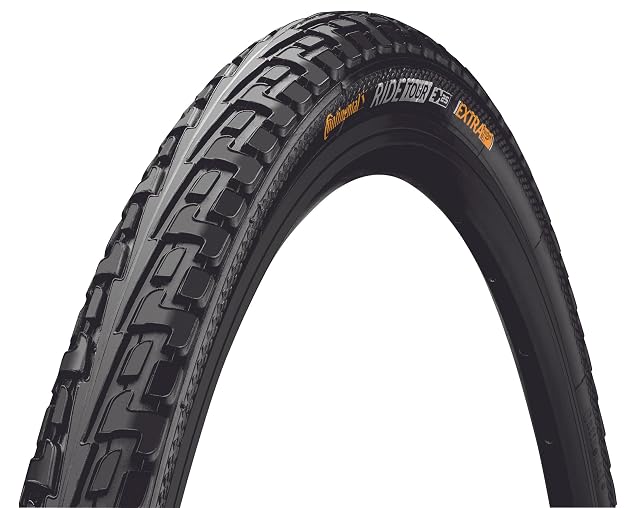
The Continental Ride Tour on this page is also E25; nothing else here carries one.
Dual Compound, without the numbers
“Two distinct rubber compounds are used within the tread to offer a balance between rolling resistance and grip.”
Harder in the center for wear and rolling, softer on the shoulders for grip. It is the standard arrangement and Maxxis does not publish the durometers, so the softness of the shoulder cannot be compared with another tire’s.
What is not published
No TPI, no tread depth, no pressure range, no load rating, no tubeless statement — the description field mentions “TLR” but no bullet does, and that is the one question worth resolving before ordering a tire of this kind.
At 2.1 lb (0.9 kg) it is the heaviest tire on this page.
Availability
Read on the day this page was built: $57 at the American Amazon shop.
Read from Keepa on the day this page was last revised; stock and price both move without notice.
Prices quoted in this text are dated readings and can differ from the live price in the buy box.
The questions riders ask
What rim does it need?
Maxxis publishes the window, which is unusual: 30 mm (1.18 in) internal width is ideal, and 19 to 35 mm (0.75 to 1.38 in) is usable. The tread profile was designed around 30 mm (1.18 in) — on a narrow rim a 2.4-inch casing rolls onto its shoulder knobs in corners and the pattern stops behaving as intended. Measure bead seat to bead seat inside your rim before ordering.
Is EXO the same as a puncture belt?
No, and the difference is where it sits. EXO is added to the sidewalls, against rocks slicing the flank — which is how a mountain tire usually dies. The nylon layers on the Fincci tires on this page, and Continental’s ExtraPuncture Belt, sit under the tread, against thorns and glass. Two different failures, two different places to put material; neither protects against the other.
Can it be run tubeless?
No bullet says so, and on a tire of this kind that is the omission that matters — the Minion DHR II is normally run tubeless, and the supplier description field mentions "TLR", but a description field is not a specification. Confirm with the seller before ordering, because a non-tubeless casing cannot be made to hold sealant safely.
Who buys this one, among MTB and gravel tires
A 27.5-inch trail bike on a 25–30 mm (0.98 to 1.18 in) internal rim, ridden on loose ground
If this is not it: the rest of the MTB and gravel tires
At $58, it sits +20 % against the $48 median of the 10 models in this category published here.
The recorded price, among MTB and gravel tires
Details checked on October 31, 2026.
Sources
Specifications: the manufacturer sheet for MTB and gravel tires and the matching Amazon product page. Prices and availability: Keepa. Every figure on this page names its source.